“They shall go hindmost with their standards.”

July 18, 2026

Numbers 2:31

The camp of Dan brought up the rear when the armies of Israel were on the march. The Danites occupied the hindmost place, but what mattered the position, since they were as truly part of the host as were the foremost tribes; they followed the same fiery cloudy pillar, they ate of the same manna, drank of the same spiritual rock, and journeyed to the same inheritance. Come, my heart, cheer up, though last and least; it is thy privilege to be in the army, and to fare as they fare who lead the van. Some one must be hindmost in honour and esteem, some one must do menial work for Jesus, and why should not I? In a poor village, among an ignorant peasantry; or in a back street, among degraded sinners, I will work on, and “go hindmost with my standard.”

The Danites occupied a very useful place. Stragglers have to be picked up upon the march, and lost property has to be gathered from the field. Fiery spirits may dash forward over untrodden paths to learn fresh truth, and win more souls to Jesus; but some of a more conservative spirit may be well engaged in reminding the church of her ancient faith, and restoring her fainting sons. Every position has its duties, and the slowly moving children of God will find their peculiar state one in which they may be eminently a blessing to the whole host.

The rear guard is a place of danger. There are foes behind us as well as before us. Attacks may come from any quarter. We read that Amalek fell upon Israel, and slew some of the hindmost of them. The experienced Christian will find much work for his weapons in aiding those poor doubting, desponding, wavering, souls, who are hindmost in faith, knowledge, and joy. These must not be left unaided, and therefore be it the business of well-taught saints to bear their standards among the hindmost. My soul, do thou tenderly watch to help the hindmost this day.

Charles Spurgeon


Hope for American (and all) Christians – Part II

July 4, 2026

Someone recently read a post here from over ten years ago with the title: “Hope for American Christians.”

While looking at it to remember it, a question came to mind: “What better subject can one bring up on the 250th anniversary of of our nation’s founding?” I am reprinting it today with a few changes because I think America needs hope on this day. -CR

****************************************

“When Your Concern For Your Nation Intensifies” was the title of a sermon I heard today.  The sermon was presented by Pastor Mark Cain of Village Bible Church.

So what do we do about all of the things in our society that sadden us?  Pastor Mark mentioned many of the issues that can make one wonder just where we are headed: lack of morality, dishonesty, ungodly living arrangements, violence, abortion, greed, etc.

The answer Pastor Cain gave was not surprising.  It came from the Bible.  Isn’t that where we are supposed to look for our answers? He found a great answer.

“When your concern for America intensifies, calm that concern through the theology of Psalm 46.” 

Here is your answer:

Psalm 46

God the Refuge of His People.

46 God is our refuge and strength, A very present help in trouble. Therefore we will not fear, though the earth should change And though the mountains slip into the heart of the sea; Though its waters roar and foam, Though the mountains quake at its swelling pride. Selah.

There is a river whose streams make glad the city of God, The holy dwelling places of the Most High. God is in the midst of her, she will not be moved; God will help her when morning dawns. The nations made an uproar, the kingdoms tottered; He raised His voice, the earth melted. The Lord of hosts is with us; The God of Jacob is our stronghold. Selah.

Come, behold the works of the Lord, Who has wrought desolations in the earth. He makes wars to cease to the end of the earth; He breaks the bow and cuts the spear in two; He burns the chariots with fire. 10 “Cease striving and know that I am God; I will be exalted among the nations, I will be exalted in the earth.” 11 The Lord of hosts is with us; The God of Jacob is our stronghold. Selah.

Pastor Mark calls the Psalms “God’s Pharmacy.”  This Psalm shows why.

The Psalm is a song or poetry set in three stanzas.  Each stanza ends with the word “Selah.”  As the good pastor stated, no one knows for certain what the word means.  Many feel that “Selah” is word that means pause.  Pausing is always good for reflection.

Dr. Cain broke the Psalm into two sections.

1. (vv. 1-3) GOD IS (a way of saying “theology”) so personally present there is no reason to fear the cataclysmic chaos.

2. (vv. 4-11) God is so powerfully present He can overrule any national threat.

The conclusion:

“Peace and security are not the absence of threatening circumstances, but the close presence of our powerful, personally involved God.”

Our nation’s celebration of Independence is here.  God has richly blessed our nation in the past.  Psalm 46 is a great scripture upon which to dwell in the present.

I wish you a blessed Fourth of July, 2026.

Chris Reimers

(1) http://www.biblegateway.com/passage/?search=Psalm%2046&version=NASB

The Original Post


He’s the Reason to Go On

June 7, 2026

I am with you always

May 10, 2026

“I am with you always”
Matthew 28:20

It is well there is One who is ever the same, and who is ever with us. It is well there is one stable rock amidst the billows of the sea of life. O my soul, set not thine affections upon rusting, moth-eaten, decaying treasures, but set thine heart upon him who abides forever faithful to thee. Build not thine house upon the moving quicksands of a deceitful world, but found thy hopes upon this rock, which, amid descending rain and roaring floods, shall stand immovably secure. My soul, I charge thee, lay up thy treasure in the only secure cabinet; store thy jewels where thou canst never lose them. Put thine all in Christ; set all thine affections on his person, all thy hope in his merit, all thy trust in his efficacious blood, all thy joy in his presence, and so thou mayest laugh at loss, and defy destruction. Remember that all the flowers in the world’s garden fade by turns, and the day cometh when nothing will be left but the black, cold earth. Death’s black extinguisher must soon put out thy candle. Oh! how sweet to have sunlight when the candle is gone! The dark flood must soon roll between thee and all thou hast; then wed thine heart to him who will never leave thee; trust thyself with him who will go with thee through the black and surging current of death’s stream, and who will land thee safely on the celestial shore, and make thee sit with him in heavenly places forever. Go, sorrowing son of affliction, tell thy secrets to the Friend who sticketh closer than a brother. Trust all thy concerns with him who never can be taken from thee, who will never leave thee, and who will never let thee leave him, even “Jesus Christ, the same yesterday, and today, and forever.” “Lo, I am with you alway,” is enough for my soul to live upon, let who will forsake me.

Charles Spurgeon


Quotes #41…Richard Sibbes 1577–1635

March 23, 2026

“There is more grace in Christ than there is sin in us.”

Richard Sibbes


From the Garden to Glory by Bruce Cooper

March 20, 2026

I just finished reading From the Garden to Glory by Bruce Cooper who blogs at the REASONED CASES FOR CHRIST blog. I think every Christian could benefit greatly from reading this excellent work. Bruce examines how God revealed Himself gradually over time, with the Old Testament setting the stage and the New Testament providing fulfillment.  Instead of organizing doctrine by topic (like Systematic Theology), Biblical theology tracks the unfolding story of salvation chronologically (redemption history). Bruce covers the entire Bible in 136 pages. I found this very helpful and will be using it as a study reference in the future. Follow the link below to find that Bruce has provided a freely available link to a PDF of this work. May God bless your studies of His Word! -CR


Quotes #39…John Owen 1616-1683

March 9, 2026

“The growth of trees and plants takes place so slowly that it is not easily seen. Daily we notice little change. But, in course of time, we see that a great change has taken place. So it is with grace. Sanctification is a progressive, lifelong work (Prov 4:18). It is an amazing work of God’s grace and it is a work to be prayed for (Rom 8:27).” – John Owen

“I do not understand how a man can be a true believer, in whom sin is not the greatest burden, sorrow and trouble.” -John Owen

John Owen (Click here for biographical information on John Owen. There are advertisements on the site from which I do not profit. – CR)


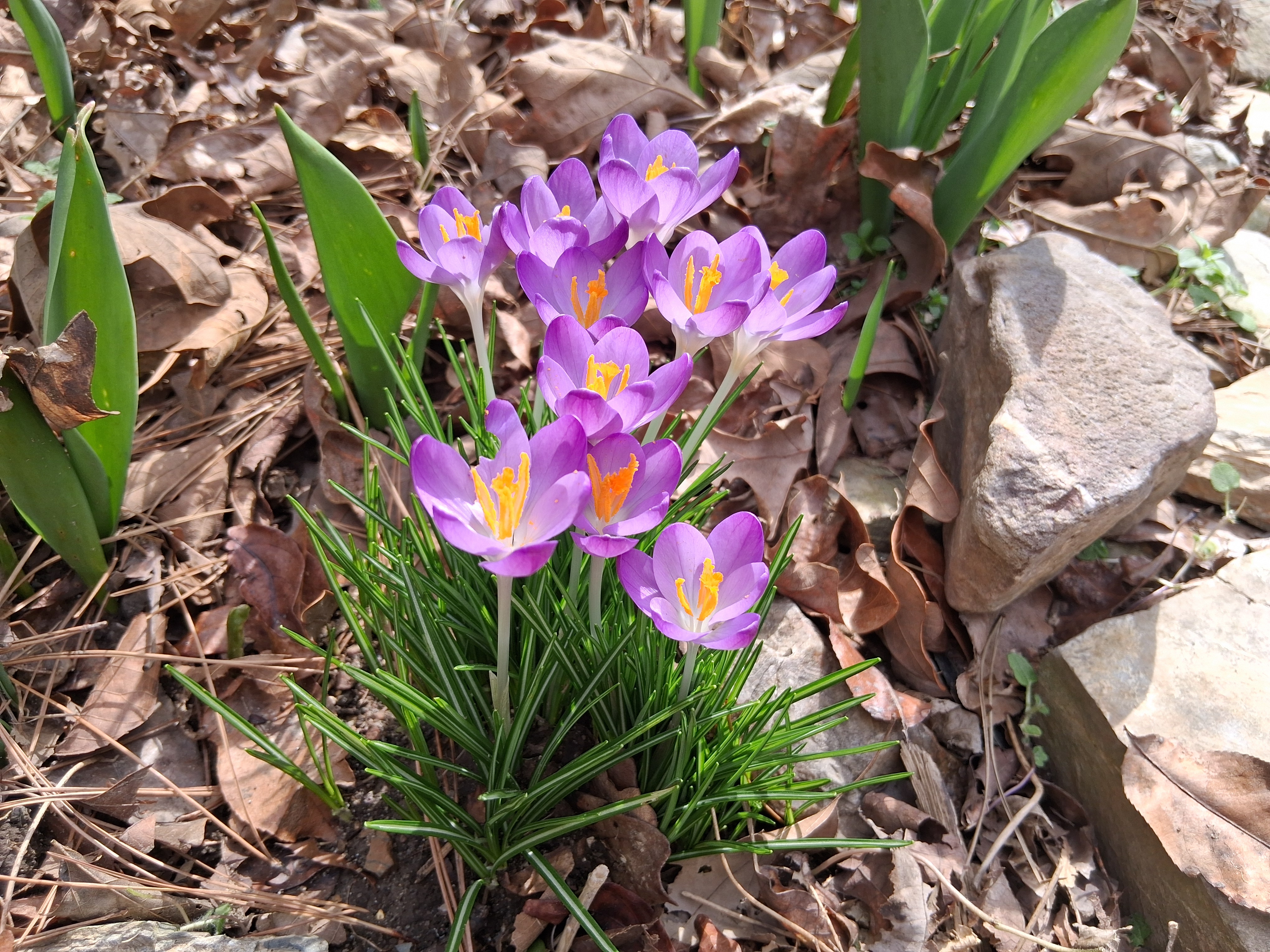
Crocus Celebration

March 4, 2026

Being painfully aware that this blog lacks actual color of late, I have decided to share an occasional picture from my garden this year. As God will be responsible for any picture I take, I must give Him attribution. I’m just holding a phone sorta steady and clicking on an icon. Some of you may have wondered where so many of the pictures that once graced the scribbling here went. I decided to ditch many of them because they hadn’t the proper attribution. In any case, I know all the places where one can get free pictures for a blog post if I want one but many of my recent posts are more about colorful words than pictures.

This grouping of flowers reminded me of these verses from my favorite sermon:

27 “And who of you by being worried can add a single hour to his life? 28 And why are you worried about clothing? Observe how the lilies of the field grow; they do not toil nor do they spin, 29 yet I say to you that not even Solomon in all his glory clothed himself like one of these.”

By the way, the only contribution I made to what is in the picture was the dividing of crocus roots last year.

I know these colors will clash with my header, but I hope it’s not too unbearable. (Maybe it’s time for the old header to go!)

Chris Reimers 


Quotes #37…John Maynard 1600-1665

February 23, 2026

Christ’s satisfaction and righteousness is the full, perfect, and only cause of justification and pardon of sin, and that no holiness, no duties of the persons justified, help anything at all towards their justification; it is the Righteousness of Christ imputed to them, which maketh up the whole matter of their Righteousness in the sight of God, and covereth all their sins.

John Maynard

(Click on John’s name to view a short biography. The page has ads from which I do not profit. – CR)


“I have learned…to be content”

February 19, 2026

“I have learned, in whatever state I am, therewith to be content.”
Philippians 4:11

These words show us that contentment is not a natural propensity of man. “Ill weeds grow apace.” Covetousness, discontent, and murmuring are as natural to man as thorns are to the soil. We need not sow thistles and brambles; they come up naturally enough, because they are indigenous to earth: and so, we need not teach men to complain; they complain fast enough without any education. But the precious things of the earth must be cultivated. If we would have wheat, we must plough and sow; if we want flowers, there must be the garden, and all the gardener’s care. Now, contentment is one of the flowers of heaven, and if we would have it, it must be cultivated; it will not grow in us by nature; it is the new nature alone that can produce it, and even then we must be specially careful and watchful that we maintain and cultivate the grace which God has sown in us. Paul says, “I have learned … to be content;” as much as to say, he did not know how at one time. It cost him some pains to attain to the mystery of that great truth. No doubt he sometimes thought he had learned, and then broke down. And when at last he had attained unto it, and could say, “I have learned in whatsoever state I am, therewith to be content,” he was an old, grey-headed man, upon the borders of the grave–a poor prisoner shut up in Nero’s dungeon at Rome. We might well be willing to endure Paul’s infirmities, and share the cold dungeon with him, if we too might by any means attain unto his good degree. Do not indulge the notion that you can be contented without learning, or learn without discipline. It is not a power that may be exercised naturally, but a science to be acquired gradually. We know this from experience. Brother, hush that murmur, natural though it be, and continue a diligent pupil in the College of Content.

From Charles Spurgeon’s Morning and Evening