TWO CHOICES

June 7, 2010

After reading an email this morning, sent to me by Madge Franks, I had two choices.  I could post it today or post it later.  With words of war in the air, which is more important, this or that?  There is no question in my mind that this is more important.  This story could make your day a better one.

I tried many times to enlarge the words.  You’ll have to use the control+ and control- to toggle to larger and smaller.

Chris Reimers

What would you do?....you make the choice. Don't look for a punch line, there isn't one. Read it anyway. My question is: Would you have made the same choice?
At a fundraising dinner for a school that serves children with learning disabilities, the father of one of the students delivered a speech that would never be forgotten by all who attended. After extolling the school and its
dedicated  staff, he offered a question:
'When not interfered with by outside influences, everything nature does, is done with perfection.
Yet my son, Shay, cannot learn things as other children do. He cannot understand things as other children do.
Where is the natural order of things in my son?'
The audience was stilled by the query.
The father continued. 'I believe that when a child like Shay, who was mentally and physically disabled comes into the world, an opportunity to realize true human nature presents itself, and it comes in the way other people treat that child.'
Then he told  the following story:
Shay and I had walked past a park where some boys Shay knew were playing baseball. Shay asked, 'Do you think they'll let me play?' I knew that most of the boys would not want someone like Shay on their team, but as a father I also understood that if my son were allowed to play, it would give him a much-needed sense of belonging and some confidence to be accepted by others in spite of his handicaps.
I approached one of the boys on the field and asked (not expecting much) if Shay could play. The boy looked around for guidance and said, 'We're losing by six runs and the game is in the eighth inning. I guess he can be on our team and we'll try to put him in to bat in the ninth inning.'
Shay struggled over to the team's bench and, with a broad smile, put on a team shirt. I watched with a small tear in my eye and warmth in my heart. The boys saw my  joy at my son being accepted.
In the bottom of the eighth inning, Shay's team scored a few runs but was still behind by three.
In the top of the ninth inning, Shay put on a glove and played in the right field. Even though no hits came his way, he was obviously ecstatic just to be in the game and on the field, grinning from ear to ear as I waved to him from the stands.
In the bottom of the ninth inning, Shay's team scored again.
Now, with two outs and the bases loaded, the potential winning run was on base and Shay was scheduled to be next at bat.
At this juncture, do they let Shay bat and give away their chance to win the game?
Surprisingly, Shay was given the bat. Everyone knew that a hit was all but impossible because Shay didn't even know how to hold the bat properly, much less connect with the ball.
However, as Shay stepped up to the
plate, the pitcher, recognizing that the  other team was putting winning aside for this moment in Shay's life, moved in a few steps to lob the ball in softly so Shay could at least make contact.
The first pitch came and Shay swung clumsily and missed.
The pitcher again took a few steps forward to toss the ball softly towards Shay.
As the pitch came in, Shay swung at the ball and hit a slow ground ball right back to the pitcher.
The game would now be over.
The pitcher picked up the soft grounder and could have easily thrown the ball to the first baseman.
Shay would have been out and that would have been the end of the game.
Instead, the pitcher threw the ball right over the first baseman's head, out of reach of all team mates.
Everyone from the stands and both teams started yelling, 'Shay, run to first!
Run to first!'
Never in his life had Shay ever run that far, but he made it to first base.
He  scampered down the baseline, wide-eyed and startled.
Everyone yelled, 'Run to second, run to second!'
Catching his breath, Shay awkwardly ran towards second, gleaming and struggling to make it to the base.
B y the time Shay rounded towards second base, the right fielder had the ball . the smallest guy on their team who now had his first chance to be the hero for his team.
He could have thrown the ball to the second-baseman for the tag, but he understood the pitcher's intentions so he, too, intentionally threw the ball high and far over the third-baseman's head.
Shay ran toward third base deliriously as the runners ahead of him circled the bases toward home.
All were screaming, 'Shay, Shay, Shay, all the Way Shay'
Shay reached third base because the opposing shortstop ran to help him by turning him in the direction of third base, and shouted, 'Run to third!
Shay, run to  third!'
As Shay rounded third, the boys from both teams, and the spectators, were on their feet screaming, 'Shay, run home! Run home!'
Shay ran to home, stepped on the plate, and was cheered as the hero who hit the grand slam and won the game for his team
'That day', said the father softly with tears now rolling down his face, 'the boys from both teams helped bring a piece of true love and humanity into this world'.
Shay didn't make it to another summer. He died that winter, having never forgotten being the hero and making me so happy, and coming home and seeing his Mother tearfully embrace her little hero of the day!
AND NOW A LITTLE FOOT NOTE TO THIS STORY:
We all send thousands of jokes through the e-mail without a second thought, but when it comes to sending messages about life choices, people hesitate.
The crude, vulgar, and often obscene pass freely through  cyberspace, but public discussion about decency is too often suppressed in our schools and workplaces.
If you're thinking about forwarding this message, chances are that you're probably sorting out the people in your address book who aren't the 'appropriate' ones to receive this type of message Well, the person who sent you this believes that we all can make a difference.
We all have thousands of opportunities every single day to help realize the 'natural order of things.'
So many seemingly trivial interactions between two people present us with a choice:
Do we pass along a little spark of love  and humanity or do we pass up those opportunities and leave the world a little bit colder in the process?
A wise man once said every society is judged by how it treats it's least fortunate amongst them.
You now have two choices:
1. Delete
2. Forward
May your day, be a Shay Day.


INTO ALL THE WORLD

June 6, 2010

Tomorrow they begin at the beginning.

by Jackie Fallis

The missionary team Elias and José Struik, Lisa Kappeler and Matt and Rachel Clayton present Genesis 1:1 to the Uriay people of Papua New Guinea tomorrow.

On Sunday the team started with why they’re teaching this way as well as the big picture of things — where the Uriay are in relation to the rest of the world.

Monday was spent explaining how time is linear with beginning and end, and how people have held to ancestral beliefs all around the world, but that the One who made everything communicates truth via His Word.

The team delved into how they know this is the truth and God’s authority on Tuesday and Wednesday, going further to talk about the many languages His Word is in.

Thursday is when they launch into God’s story.

From house building in 2004 to beginning to learn the culture and language, from teaching literacy to writing the Bible lessons, all of the work culminates in this.

It’s not without challenges. An Uriay woman recently committed suicide a couple of weeks ago, something virtually unheard of in their culture. They don’t believe suicide is actually possible. It’s blamed on sorcery. Due to fear of sorcery the people were actually thinking of leaving the village and falling back to one more hidden in the jungle.

“We shared our thoughts with them and tried to encourage them that they’re just about to hear the Truth and it will give life and peace,” wrote Lisa Kappeler. “Their whole mindset seemed to change and they went from ‘we’re absolutely moving’ to ‘perhaps we should stay here to hear this talk.'”

Then the village emptied out, and the missionaries were left wondering who would be there for the teaching.

Lisa wrote, “But all of us felt that we needed to rest in the Lord and wait on His timing. So we waited, and as the next two weeks went on, three couples came back, and visits with folks that came back for the day gave us indications that most of the folks would be back.”

“We’re actually expecting most of the village and some from our other two villages to arrive later this afternoon. There were a couple people that I told someone that it would take a miracle for them to be here — and from what I’ve heard recently, they’ll be here!”

Please pray that the lessons will be well-attended and that it will be clear to all who hear it. Pray further that the missionaries will be able to expand on the concepts in the lessons in one-on-one conversations.

http://www.ntm.org/news/10989


PRAISING

June 3, 2010

PRAISING

Psalm 148

The Whole Creation Invoked to Praise the LORD.

1Praise the LORD!
Praise the LORD (A)from the heavens;
Praise Him (B)in the heights!
2Praise Him, (C)all His angels;
Praise Him, (D)all His hosts!
3Praise Him, sun and moon;
Praise Him, all stars of light!
4Praise Him, (E)highest heavens,
And the (F)waters that are above the heavens!
5Let them praise the name of the LORD,
For (G)He commanded and they were created.
6He has also (H)established them forever and ever;
He has made a (I)decree which will not pass away.
7Praise the LORD from the earth,
(J)Sea monsters and all (K)deeps;
8(L)Fire and hail, (M)snow and (N)clouds;
(O)Stormy wind, (P)fulfilling His word;
9(Q)Mountains and all hills;
Fruit (R)trees and all cedars;
10(S)Beasts and all cattle;
(T)Creeping things and winged fowl;
11(U)Kings of the earth and all peoples;
Princes and all judges of the earth;
12Both young men and virgins;
Old men and children.
13Let them praise the name of the LORD,
For His (V)name alone is exalted;
His (W)glory is above earth and heaven.
14And He has (X)lifted up a horn for His people,
(Y)Praise for all His godly ones;
Even for the sons of Israel, a people (Z)near to Him.
Praise the LORD!

Cross references:

  1. Psalm 148:1 : Ps 69:34
  2. Psalm 148:1 : Job 16:19; Ps 102:19; Matt 21:9
  3. Psalm 148:2 : Ps 103:20
  4. Psalm 148:2 : Ps 103:21
  5. Psalm 148:4 : Deut 10:14; 1 Kin 8:27; Neh 9:6; Ps 68:33
  6. Psalm 148:4 : Gen 1:7
  7. Psalm 148:5 : Gen 1:1; Ps 33:6, 9
  8. Psalm 148:6 : Ps 89:37; Jer 31:35, 36; 33:20, 25
  9. Psalm 148:6 : Job 38:33
  10. Psalm 148:7 : Gen 1:21; Ps 74:13
  11. Psalm 148:7 : Gen 1:2; Deut 33:13; Hab 3:10
  12. Psalm 148:8 : Ps 18:12
  13. Psalm 148:8 : Ps 147:16
  14. Psalm 148:8 : Ps 135:7
  15. Psalm 148:8 : Ps 107:25
  16. Psalm 148:8 : Job 37:12; Ps 103:20
  17. Psalm 148:9 : Is 44:23; 49:13
  18. Psalm 148:9 : Is 55:12
  19. Psalm 148:10 : Is 43:20
  20. Psalm 148:10 : Hos 2:18
  21. Psalm 148:11 : Ps 102:15
  22. Psalm 148:13 : Is 12:4
  23. Psalm 148:13 : Ps 8:1; 113:4
  24. Psalm 148:14 : 1 Sam 2:1; Ps 75:10
  25. Psalm 148:14 : Deut 10:21; Ps 109:1; Jer 17:14
  26. Psalm 148:14 : Lev 10:3; Eph 2:17

JAMES TAKES FIRST STEPS

June 2, 2010

The Trent Family at Change Point

Every once in a while you have one of those experiences.  I had one yesterday.

A family came into the Center to continue parenting classes.  I was blessed to be the one to spend time with them.

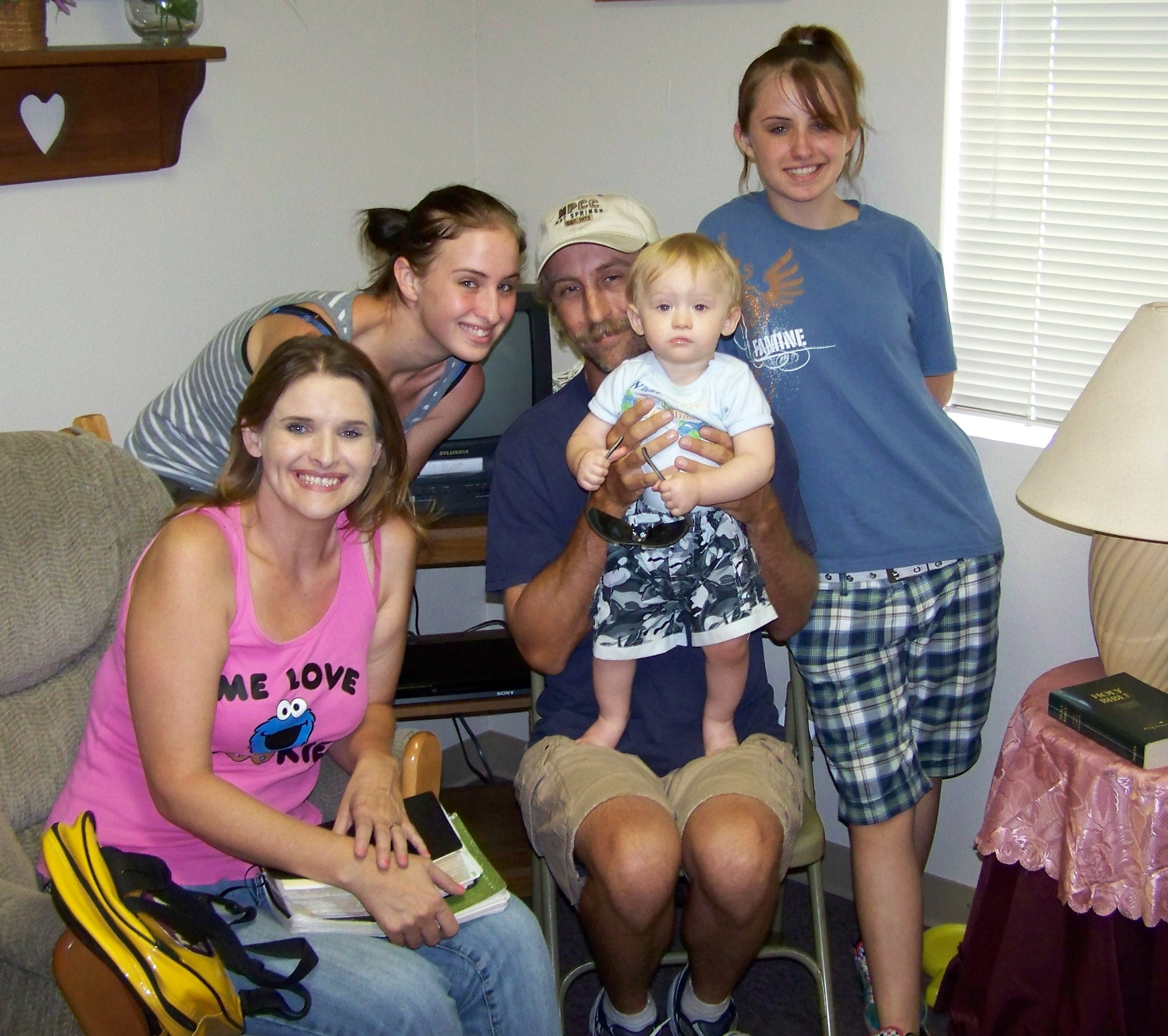
Bobby Trent, the one with the hat on in the picture above, is holding his grandson James. Bobby is Shandi’s father.  Shandi is the one with the big smile on the left of her Dad as you look at the Picture. James is Shandi’s son.

Cindy Trent, Bobby’s wife (pink shirt) was there also, along with Vanessa (blue shirt).  Vanessa and Shandi are sisters.

We had our session in one of the counseling rooms at Change Point (There is a link below if you would like to see the Change Point website).  The subject for the day was communication, and James was in the mood to do just that.  He was chatting from the time we walked into the room, was very patient with me throughout, and clearly understood most of what went on.

While playing on the floor during the discussion, James reached over and grabbed my shoe.  I had been accepted.

About half-way through our “class,” Vanessa was clearly startled by something that had happened.

I asked her about it.

“James just walked,” she said.  “He walked for the first time.”

“I didn’t see it,” said his mom.

“It’s OK,” I said. “You’ll see plenty of it.”

The room was quiet.

I wish I could quote word for word what Shandi said next.  Maybe Shandi remembers and can tell me.  She has a great memory.  She knows how I know this.

“My job just got harder,” she stated.

Laughter filled the room.

I didn’t see James take his first step and I can’t remember mine.  However, I felt it an honor to be there on the day a young child began his journey.

The word “walk” is used many times in the Bible.

God said this to King Solomon:

“If you walk in My ways, keeping My statutes and commandments, as your father David walked, then I will prolong your days.”

Solomon began his prayer of Temple dedication with these words:

“O LORD, the God of Israel, there is no God like You in heaven above or on earth beneath, keeping covenant and showing lovingkindness to Your servants who walk before You with all their heart.”

These are the first words in the Psalms:

“How blessed is the man who does not walk in the counsel of the wicked,
Nor stand in the path of sinners,
Nor sit in the seat of scoffers!
But his delight is in the law of the LORD,
And in His law he meditates day and night.”

Luke describes Zacharias and Elizabeth, the parents of John the Baptist, like this:

“They were both righteous in the sight of God, walking blamelessly in all the commandments and requirements of the Lord.”

In his letter to the people of Rome, Paul wrote:

“Therefore we have been buried with Him through baptism into death, so that as Christ was raised from the dead through the glory of the Father, so we too might walk in newness of life.”

James took his first steps yesterday.  He is a blessed little boy.  He has a mom, aunt, and grandparents who believe in the words quoted above.

I was blessed to be there for his first steps.  May God continue to be with James and bless his walk through life.

Chris Reimers

http://changepointcenter.com


WHO HEALETH ALL THY DISEASES

May 31, 2010

 “Who healeth all thy diseases.” —Psalm 103:3

Humbling as is the statement, yet the fact is certain, that we are all more or less suffering under the disease of sin. What a comfort to know that we have a great Physician who is both able and willing to heal us! Let us think of him awhile today. His cures are very speedy –there is life in a look at him; his cures are radical –he strikes at the center of the disease; and hence, his cures are sure and certain. He never fails, and the disease never returns. There is no relapse where Christ heals; no fear that his patients should be merely patched up for a season, he makes new men of them: a new heart also does he give them, and a right spirit does he put with them. He is well skilled in all diseases. Physicians generally have some specialty. Although they may know a little about almost all our pains and ills, there is usually one disease which they have studied above all others; but Jesus Christ is thoroughly acquainted with the whole of human nature. He is as much at home with one sinner as with another, and never yet did he meet with an out of the way case that was difficult to him. He has had extraordinary complications of strange diseases to deal with, but he has known exactly with one glance of his eye how to treat the patient. He is the only universal doctor; and the medicine he gives is the only true catholicon, healing in every instance. Whatever our spiritual malady may be, we should apply at once to this Divine Physician. There is no brokenness of heart which Jesus cannot bind up. “His blood cleanseth from all sin.” We have but to think of the myriads who have been delivered from all sorts of diseases through the power and virtue of his touch, and we shall joyfully put ourselves in his hands. We trust him, and sin dies; we love him, and grace lives; we wait for him and grace is strengthened; we see him as he is, and grace is perfected for ever.

Charles H. Spurgeon  (from top link in “links” section)


WEEPING MAY ENDURE FOR A NIGHT, BUT JOY COMETH IN THE MORNING

May 21, 2010

“Weeping may endure for a night, but joy cometh in the morning.” —Psalm 30:5

Christian! If thou art in a night of trial, think of the morrow; cheer up thy heart with the thought of the coming of thy Lord. Be patient, for

“Lo! He comes with clouds descending.”

Be patient! The Husbandman waits until he reaps his harvest. Be patient; for you know who has said, “Behold, I come quickly; and my reward is with me, to give to every man according as his work shall be.” If you are never so wretched now, remember

“A few more rolling suns, at most,

Will land thee on fair Canaan’s coast.”

Thy head may be crowned with thorny troubles now, but it shall wear a starry crown ere long; thy hand may be filled with cares–it shall sweep the strings of the harp of heaven soon. Thy garments may be soiled with dust now; they shall be white by and by. Wait a little longer. Ah! how despicable our troubles and trials will seem when we look back upon them! Looking at them here in the prospect, they seem immense; but when we get to heaven we shall then

“With transporting joys recount,

The labours of our feet.”

Our trials will then seem light and momentary afflictions. Let us go on boldly; if the night be never so dark, the morning cometh, which is more than they can say who are shut up in the darkness of hell. Do you know what it is thus to live on the future–to live on expectation–to antedate heaven? Happy believer, to have so sure, so comforting a hope. It may be all dark now, but it will soon be light; it may be all trial now, but it will soon be all happiness. What matters it though “weeping may endure for a night”, when “joy cometh in the morning?”

Charles H. Spurgeon


HE SHALL GATHER THE LAMBS WITH HIS ARM

May 14, 2010

“He shall gather the lambs with his arm, and carry them in his bosom.” —Isaiah 40:11

Who is he of whom such gracious words are spoken? He is THE GOOD SHEPHERD. Why doth he carry the lambs in his bosom? Because He hath a tender heart, and any weakness at once melts his heart. The sighs, the ignorance, the feebleness of the little ones of his flock draw forth his compassion. It is his office, as a faithful High Priest, to consider the weak. Besides, he purchased them with blood, they are his property: he must and will care for that which cost him so dear. Then he is responsible for each lamb, bound by covenant engagements not to lose one. Moreover, they are all a part of his glory and reward.

But how may we understand the expression, “He will carry them?” Sometimes he carries them by not permitting them to endure much trial. Providence deals tenderly with them. Often they are “carried” by being filled with an unusual degree of love, so that they bear up and stand fast. Though their knowledge may not be deep, they have great sweetness in what they do know. Frequently he “carries” them by giving them a very simple faith, which takes the promise just as it stands, and believingly runs with every trouble straight to Jesus. The simplicity of their faith gives them an unusual degree of confidence, which carries them above the world.

“He carries the lambs in his bosom.” Here is boundless affection. Would he put them in his bosom if he did not love them much? Here is tender nearness: so near are they, that they could not possibly be nearer. Here is hallowed familiarity: there are precious love passages between Christ and his weak ones. Here is perfect safety: in his bosom who can hurt them? They must hurt the Shepherd first. Here is perfect rest and sweetest comfort. Surely we are not sufficiently sensible of the infinite tenderness of Jesus!

Charles H. Spurgeon


JESUS MANIFESTS HIMSELF TO HIS PEOPLE

May 12, 2010

“And will manifest myself to him.” —John 14:21

The Lord Jesus gives special revelations of himself to his people. Even if Scripture did not declare this, there are many of the children of God who could testify the truth of it from their own experience. They have had manifestations of their Lord and Saviour Jesus Christ in a peculiar manner, such as no mere reading or hearing could afford. In the biographies of eminent saints, you will find many instances recorded in which Jesus has been pleased, in a very special manner to speak to their souls, and to unfold the wonders of his person; yea, so have their souls been steeped in happiness that they have thought themselves to be in heaven, whereas they were not there, though they were well nigh on the threshold of it–for when Jesus manifests himself to his people, it is heaven on earth; it is paradise in embryo; it is bliss begun. Especial manifestations of Christ exercise a holy influence on the believer’s heart. One effect will be humility. If a man says, “I have had such and such spiritual communications, I am a great man”, he has never had any communion with Jesus at all; for “God hath respect unto the lowly: but the proud he knoweth afar off.” He does not need to come near them to know them, and will never give them any visits of love. Another effect will be happiness; for in God’s presence there are pleasures for evermore. Holiness will be sure to follow. A man who has no holiness has never had this manifestation. Some men profess a great deal; but we must not believe anyone unless we see that his deeds answer to what he says. “Be not deceived; God is not mocked.” He will not bestow his favours upon the wicked: for while he will not cast away a perfect man, neither will he respect an evil doer. Thus there will be three effects of nearness to Jesus–humility, happiness, and holiness. May God give them to thee, Christian!

Charles H. Spurgeon, taken from Morning and Evening

http://www.answersingenesis.org/devotions/devotions.asp


GREATNESS IS FOUND IN UNUSUAL PLACES

May 9, 2010

As I have grown older, I have come to realize that you just never know.  A person that you don’t notice may have done a great deed that no one will ever recognize.  This is the nature of humility.  People who demonstrate this trait blend in.  It is because of their humility that their stories are never known.

I was drawn to this article, sent to me by Barbara Anable, because my brother was at the Air Force Academy about the same time that the story took place.  I didn’t made it to the 10 leadership lessons (included in the story below) until a second reading. On the first reading, the man tears came way before the leadership lessons. Man tears are those that don’t show much because you are a male.  For some reason, this story hit me at my core.  Maybe it’s because I know a few people like this, and they have been very inspirational to me. -CR

LESSONS IN LEADERSHIP: From a Janitor

Wharton Leadership Digest, December 2001

By Colonel James E. Moschgat,Commander of the 12th
Operations Group, 12th Flying Training Wing, Randolph
Air Force Base, Texas

William “Bill” Crawford certainly was an unimpressive figure, one you could easily overlook during a hectic day at the U.S. Air Force Academy. Mr. Crawford, as most of us referred to him back in the late 1970s, was our squadron janitor.

We cadets busied ourselves preparing for academic exams, athletic events, Saturday morning parades and room inspections, or never-ending leadership classes, Bill quietly moved about the squadron mopping and buffing floors, emptying trash cans, cleaning toilets, or just tidying up the mess 100 college-age kids can leave in a dormitory. Sadly, and for many years, few of us gave him much notice, rendering little more than a passing nod or throwing a curt, “G’morning!” in his direction as we hurried off to our daily duties.

Why? Perhaps it was because of the way he did his job-he always kept the squadron area spotlessly clean, even the toilets and showers gleamed. Frankly, he did his job so well, none of us had to notice or get involved. After all, cleaning toilets was his job, not ours. Maybe it was is physical appearance that made him disappear into the background. Bill didn’t move very quickly and, in fact, you could say he even shuffled a bit, as if he suffered from some sort of injury. His gray hair and wrinkled face made him appear ancient to a group of young cadets. And his crooked smile, well, it looked a little funny. Face it, Bill was an old man working in a young person’s world. What did he have to offer us on a personal level?

Finally, maybe it was Mr. Crawford’s personality that rendered him almost invisible to the young people around him. Bill was shy, almost painfully so. He seldom spoke to a cadet unless they addressed him first, and that didn’t happen very often. Our janitor always buried himself in his work, moving about with stooped shoulders, a quiet gait, and an averted gaze. If he noticed the hustle and bustle of cadet life around him, it was hard to tell. So, for whatever reason, Bill blended into the woodwork and became just another fixture around the squadron. The Academy, one of our nation’s premier leadership laboratories, kept us busy from dawn till dusk. And Mr. Crawford…well, he was just a janitor.

That changed one fall Saturday afternoon in 1976. I was reading a book about World War II and the tough Allied ground campaign in Italy, when I stumbled across an incredible story. On September 13, 1943, a Private William Crawford from Colorado, assigned to the 36th Infantry Division, had been involved in some bloody fighting on Hill 424 near Altavilla, Italy. The words on the page leapt out at me: “in the face of intense and overwhelming hostile fire … with no regard for personal safety … on his own initiative, Private Crawford single-handedly attacked fortified enemy positions.” It continued, “for conspicuous gallantry and intrepidity at risk of life above and beyond the call of duty, the President of the United States …”

“Holy cow,” I said to my roommate, “you’re not going to believe this, but I think our janitor is a Medal of Honor winner.” We all knew Mr. Crawford was a WWII Army vet, but that didn’t keep my friend from looking at me as if I was some sort of alien being. Nonetheless, we couldn’t wait to ask Bill about the story on Monday. We met Mr. Crawford bright and early Monday and showed him the page in question from the book, anticipation and doubt in our faces. He starred at it for a few silent moments and then quietly uttered something like, “Yep, that’s me.”

Mouths agape, my roommate and I looked at one another, then at the book, and quickly back at our janitor. Almost at once we both stuttered, “Why didn’t you ever tell us about it?” He slowly replied after some thought, “That was one day in my life and it happened a long time ago.”

I guess we were all at a loss for words after that. We had to hurry off to class and Bill, well, he had chores to attend to. However, after that brief exchange, things were never again the same around our squadron. Word spread like wildfire among the cadets that we had a hero in our midst-Mr. Crawford, our janitor, had won the Medal! Cadets who had once passed by Bill with hardly a glance, now greeted him with a smile and a respectful, “Good morning, Mr. Crawford.” Those who had before left a mess for the “janitor” to clean up started taking it upon themselves to put things in order. Most cadets routinely stopped to talk to Bill throughout the day and we even began inviting him to our formal squadron functions. He’d show up dressed in a conservative dark suit and quietly talk to those who approached him, the only sign of his heroics being a simple blue, star-spangled lapel pin.

Almost overnight, Bill went from being a simple fixture in our squadron to one of our teammates. Mr. Crawford changed too, but you had to look closely to notice the difference. After that fall day in 1976, he seemed to move with more purpose, his shoulders didn’t seem to be as stooped, he met our greetings with a direct gaze and a stronger “good morning” in return, and he flashed his crooked smile more often. The squadron gleamed as always, but everyone now seemed to notice it more. Bill even got to know most of us by our first names, something that didn’t happen often at the Academy. While no one ever formally acknowledged the change, I think we became Bill’s cadets and his squadron. As often happens in life, events sweep us away from those in our past. The last time I saw Bill was on graduation day in June 1977. As I walked out of the squadron for the last time, he shook my hand and simply said, “Good luck, young man.” With that, I embarked on a career that has been truly lucky and blessed.

Mr. Crawford continued to work at the Academy and eventually retired in his native Colorado where he resides today, one of four Medal of Honor winners living in a small town.

A wise person once said, “It’s not life that’s important, but those you meet along the way that make the difference.” Bill was one who made a difference for me. While I haven’t seen Mr. Crawford in over twenty years, he’d probably be surprised to know I think of him often. Bill Crawford, our janitor, taught me many valuable, unforgettable leadership lessons. Here are ten I’d like to share with you.

1. Be Cautious of Labels. Labels you place on people may define your relationship to them and bound their potential. Sadly, and for a long time, we labeled Bill as just a janitor, but he was so much more. Therefore, be cautious of a leader who callously says, “Hey, he’s just an Airman.” Likewise, don’t tolerate the O-1, who says, “I can’t do that, I’m just a lieutenant.”

2. Everyone Deserves Respect. Because we hung the “janitor” label on Mr. Crawford, we often wrongly treated him with less respect than others around us. He deserved much more, and not just because he was a Medal of Honor winner. Bill deserved respect because he was a janitor, walked among us, and was a part of our team.

3. Courtesy Makes a Difference. Be courteous to all around you, regardless of rank or position. Military customs, as well as common courtesies, help bond a team. When our daily words to Mr. Crawford turned from perfunctory “hellos” to heartfelt greetings, his demeanor and personality outwardly changed. It made a difference for all of us.

4. Take Time to Know Your People. Life in the military is hectic, but that’s no excuse for not knowing the people you work for and with. For years a hero walked among us at the Academy and we never knew it. Who are the heroes that walk in your midst?

5. Anyone Can Be a Hero. Mr. Crawford certainly didn’t fit anyone’s standard definition of a hero. Moreover, he was just a private on the day he won his Medal. Don’t sell your people short, for any one of them may be the hero who rises to the occasion when duty calls. On the other hand, it’s easy to turn to your proven performers when the chips are down, but don’t ignore the rest of the team. Today’s rookie could and should be tomorrow’s superstar.

6. Leaders Should Be Humble. Most modern day heroes and some leaders are anything but humble, especially if you calibrate your “hero meter” on today’s athletic fields. End zone celebrations and self-aggrandizement are what we’ve come to expect from sports greats. Not Mr. Crawford-he was too busy working to celebrate his past heroics. Leaders would be well-served to do the same.

7. Life Won’t Always Hand You What You Think You Deserve. We in the military work hard and, dang it, we deserve recognition, right? However, sometimes you just have to persevere, even when accolades don’t come your way. Perhaps you weren’t nominated for junior officer or airman of the quarter as you thought you should – don’t let that stop you.

8. Don’t pursue glory; pursue excellence. Private Bill Crawford didn’t pursue glory; he did his duty and then swept floors for a living. No job is beneath a Leader. If Bill Crawford, a Medal of Honor winner, could clean latrines and smile, is there a job beneath your dignity? Think about it.

9. Pursue Excellence. No matter what task life hands you, do it well. Dr. Martin Luther King said, “If life makes you a street sweeper, be the best street sweeper you can be.” Mr. Crawford modeled that philosophy and helped make our dormitory area a home.

10. Life is a Leadership Laboratory. All too often we look to some school or PME class to teach us about leadership when, in fact, life is a leadership laboratory. Those you meet everyday will teach you enduring lessons if you just take time to stop, look and listen. I spent four years at the Air Force Academy, took dozens of classes, read hundreds of books, and met thousands of great people. I gleaned leadership skills from all of them, but one of the people I remember most is Mr. Bill Crawford and the lessons he unknowingly taught. Don’t miss your opportunity to learn.

Bill Crawford was a janitor. However, he was also a teacher, friend, role model and one great American hero. Thanks, Mr. Crawford, for some valuable leadership lessons.

Dale Pyeatt, Executive Director of the National Guard Association of Texas, comments: And now, for the “rest of the story”:

Pvt William John Crawford was a platoon scout for 3rd Platoon of Company L 1 42nd Regiment 36th Division (Texas National Guard) and won the Medal Of Honor for his actions on Hill 424, just 4 days after the invasion at Salerno.

On Hill 424, Pvt Crawford took out 3 enemy machine guns before darkness fell, halting the platoon’s advance. Pvt Crawford could not be found and was assumed dead. The request for his MOH was quickly approved. Major General Terry Allen presented the posthumous MOH to Bill Crawford’s father, George, on 11 May 1944 in Camp (now Fort) Carson, near Pueblo. Nearly two months after that, it was learned that Pvt Crawford was alive in a POW camp in Germany. During his captivity, a German guard clubbed him with his rifle. Bill overpowered him, took the rifle away, and beat the guard unconscious. A German doctor’s testimony saved him from severe punishment, perhaps death. To stay ahead of the advancing Russian army, the prisoners were marched 500 miles in 52 days in the middle of the German winter, subsisting on one potato a day. An allied tank column liberated the camp in the spring of 1945, and Pvt Crawford took his
first hot shower in 18 months on VE Day. Pvt Crawford stayed in the army before retiring as a MSG and becoming a janitor.

In 1984, President Ronald Reagan officially presented the MOH to Bill Crawford.

William Crawford passed away in 2000. He is the only U.S. Army veteran and sole Medal of Honor winner to be buried in the cemetery of the U.S. Air Force Academy.

For more on Mr. Crawford, go to:

https://www.cmohs.org/recipients/william-j-crawford


GREAT MULTITUDES FOLLOWED HIM, AND HE HEALED THEM ALL

May 7, 2010

“Great multitudes followed him, and he healed them all.” —Matthew 12:15

What a mass of hideous sickness must have thrust itself under the eye of Jesus! Yet we read not that he was disgusted, but patiently waited on every case. What a singular variety of evils must have met at his feet! What sickening ulcers and putrefying sores! Yet he was ready for every new shape of the monster evil, and was victor over it in every form. Let the arrow fly from what quarter it might, he quenched its fiery power. The heat of fever, or the cold of dropsy; the lethargy of palsy, or the rage of madness; the filth of leprosy, or the darkness of ophthalmia–all knew the power of his word, and fled at his command. In every corner of the field he was triumphant over evil, and received the homage of delivered captives. He came, he saw, he conquered everywhere. It is even so this morning. Whatever my own case may be, the beloved Physician can heal me; and whatever may be the state of others whom I may remember at this moment in prayer, I may have hope in Jesus that he will be able to heal them of their sins. My child, my friend, my dearest one, I can have hope for each, for all, when I remember the healing power of my Lord; and on my own account, however severe my struggle with sins and infirmities, I may yet be of good cheer. He who on earth walked the hospitals, still dispenses his grace, and works wonders among the sons of men: let me go to him at once in right earnest.

Let me praise him, this morning, as I remember how he wrought his spiritual cures, which bring him most renown. It was by taking upon himself our sicknesses. “By his stripes we are healed.” The Church on earth is full of souls healed by our beloved Physician; and the inhabitants of heaven itself confess that “He healed them all.” Come, then, my soul, publish abroad the virtue of his grace, and let it be “to the Lord for a name, for an everlasting sign which shall not be cut off.”

By Charles H. Spurgeon

It doesn’t surprise me that answersingenesis has chosen Charles Spurgeon’s “Evening and Morning” Devotional to share daily.  It’s my favorite too. -CR

http://www.answersingenesis.org/devotions/devotions.asp