EVOLUTION CONTROVERSY’S OUTDATED, ONE-SIDED EXPOSURE

July 6, 2013

I found this article at the Institute for Creation Research. 

As Christine states in her article, there is now better evidence for the Creationist viewpoint.  At the same time, she doesn’t deny that the footprints are important.
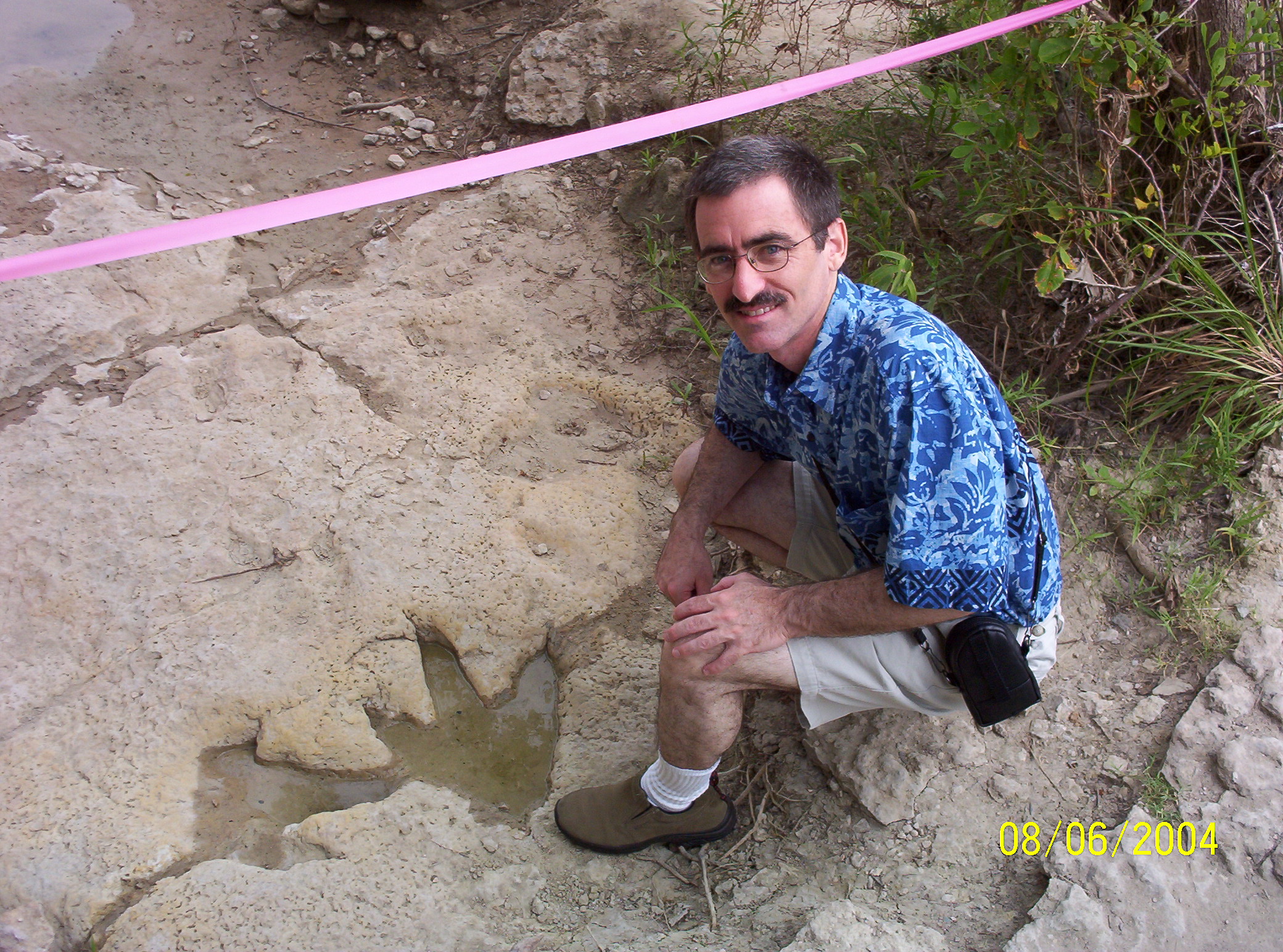
That's Me with the Dino Tracks in August of 2004
That’s Me with the Dino Tracks in August of 2004

I have been to the Paluxi River and had my picture taken next to a Dinosaur footprint.  Unfortunately, the human tracks were not visible, but this picture shows clearly that the dino tracks are there. The picture was taken at the Dinosaur Valley State Park in Texas.

It is very close to Dr. Baugh’s Creation Museum where this picture was taken:
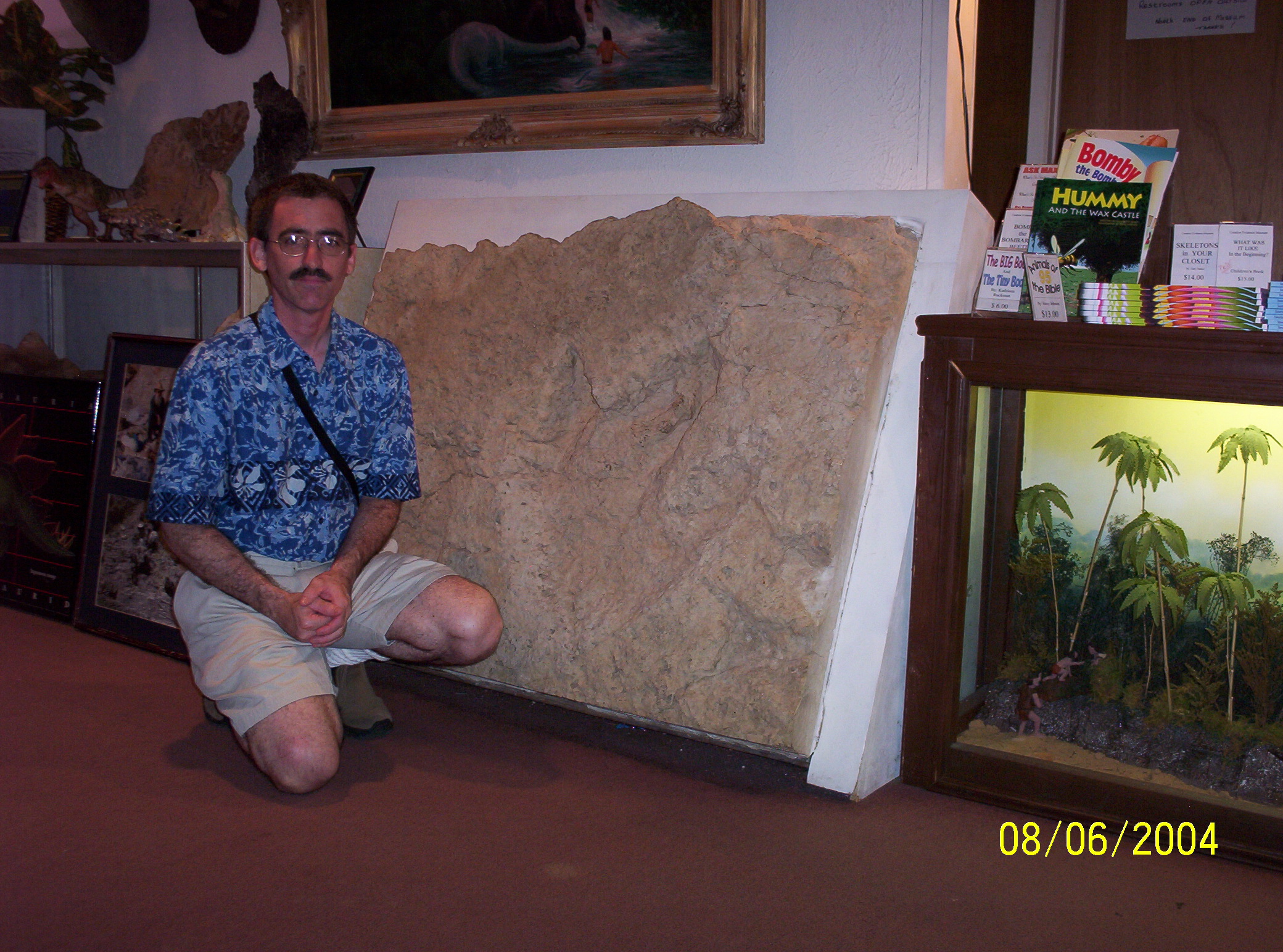
At Dr. Baugh's Creation Museum
At Dr. Baugh’s Creation Museum

An important book about the subject was published in 1980.  It was called “TRACKING Those Incredible DINOSAURS” and was written by John Morris, son of the founder of ICR.

Although ICR has backed away from the evidences found in this book, it is filled with eyewitness accounts of man and dinosaur footprints found in the same strata.  I have the book, and the accounts seem authentic to me.

One example is found on page 13.  During the Great Depression, residents of the area sold prints to make money to feed their families.  James and Cecil Ryals estimated that they quarried approx. 100 dinosaur tracks and about 10 human tracks.  Dinosaur tracks were more desirable and a good one could fetch up to 50 dollars.  The same page details how they went about their excavations.

The Ryals are not the only witnesses.  The book has other examples.

I believe in a young earth.  It is not millions and billions of years old.  I believe that man and dinosaur lived contemporaneously.  I agree that the prints discussed here are not the best evidence for Creationism, but how can one completely discount them?

The Dinosaur Valley State Park in Texas is another showcase for the Darwinian evolutionists if one reads the signs at the park.  In reality, it is evidence for Scientific Creationists like me.

Chris Reimers

Paluxy River August 2004 002

=====================================================

by Christine Dao

Appealing to public emotions is a tool employed by politicians, media, and anyone trying to win supporters for a specific agenda. Naturally, such efforts can skew or omit facts, as is often the case in mainstream presentations of the ongoing battle between evolution and creation science. A recent Discovery News feature provides a telling example of this particular ploy.

Published online July 11, the feature is titled “Evolution Controversies: A History in Photos” and includes photographs from the Scopes “Monkey” trial of 1925, a cartoon of British naturalist Charles Darwin with the body of an ape, and a photograph of an exhibit in the Institute for Creation Research’s former Museum of Creation and Earth History in Santee, California.1 Of the ten photographs, two portray what the author says are claims used by creationists as “scientific proof of young Earth creationism”: the dinosaur footprints in Glen Rose, Texas, and a petroglyph in Utah that resembles a dinosaur.

Geologist and ICR President John Morris reported on the Paluxy River footprints in 1976,2 which at the time many creation scientists believed showed human and dinosaur footprints together. However, in light of continuing study, he reexamined the issue and wrote in 1986:

Even though it would now be improper for creationists to continue to use the Paluxy data as evidence against evolution, in the light of these questions, there is still much that is not known about the tracks and continued research is in order. We stand committed to truth, and will gladly modify or abandon our previous interpretation of the Paluxy data as the facts dictate.3

So, Discovery News’ statement that “creationists claim that human footprints can be seen right beside dinosaur tracks”1 is about 25 years out of date. Creation science researchers have moved on, a fact that was omitted from the Discovery News’ emotionally oriented appeal.

In the case of the Utah petroglyph, which Discovery News reported was “just a mud stain” in March of this year,4 ICR Science Writer Brian Thomas wrote:

ICR Senior Science Lecturer Frank Sherwin visited this petroglyph a number of years ago. He commented that although it looked interesting to him, he did not consider it to be as compelling as other historical evidence—such as dinosaur original soft tissues, written or sculpted eyewitness accounts of dragon encounters from all over the world, or certain Bible passages like Job 40—that have convinced him that dinosaurs and man were contemporaneous. The case for creation does not hinge on this one Utah artifact.5

So attempts such as Discovery News’ outdated references that try to place creationists in the same unscientific camp as flat-earth believers6 do not take into account that creation science researchers are willing to examine the data and, if necessary, move on to more interesting and securely justifiable discoveries, such as the soft dinosaur tissues or historical worldwide dragon encounters Mr. Thomas mentioned.7

Discovery News’ bias is further demonstrated by the fact that, although the author was careful to include instances that he thought “disproved” creationist claims, he failed to mention examples of the supposed evidence used to support evolution and long ages that have been debunked, such the classification of Tiktaalik and Pakicetus as transitional forms (aka “missing links”),8 and the accuracy of potassium-argon radioisotope-dating techniques.9

Appealing to public emotions can be effective, because it often does not require the appealers to present all the facts surrounding the topic. However, when the dust settles, the facts will not go away. If they demonstrate anything, anti-science presentations such as the Discovery News feature show that emotional appeals are needed to promote evolution because there is no real science behind it.

References

  1. al-Khatib, T. Evolution Controversies: A History in Photos. Discovery News. Posted on news.discovery.com July 11, 2011, accessed July 14, 2011.
  2. Morris, J. D. 1976. The Paluxy River Tracks. Acts & Facts. 5 (5).
  3. Morris J. D. 1986. The Paluxy River Mystery. Acts & Facts. 15 (1).
  4. Niiler, E. ‘Proof of Creation’ Dino Drawing Just a Mud Stain. Discovery News. Posted on news.discovery.com March 25, 2011, accessed July 14, 2011.
  5. Thomas, B. Utah Dinosaur Petroglyph Disputed. ICR News. Posted on icr.org April 7, 2011, accessed July 14, 2011.
  6. Daniel Shenton of The Flat Earth Society told LiveScience in June that he and his followers believe the earth is flat: “To look around, the world does appear to be flat, so I think it is incumbent on others to prove decisively that it isn’t. And I don’t think that burden of proof has been met yet.” LiveScience also reported that Mr. Shenton believes in evolution and global warming. See Wolchover, N. Ingenious ‘Flat Earth’ Theory Revealed In Old Map. LiveScience. Posted on livescience.com June 23, 2011, accessed July 14, 2011.
  7. For examples of fresh dinosaur tissues, see the many examples listed on the “Fresh Tissues Show That Fossils Are Recent” page in ICR’s collection of Evidence for Creation. For a small sampling of archaeological examples of dinosaur interactions with humans, see Morris, J. 2008. The Dinosaur Next Door. Acts & Facts. 37 (6): 13.
  8. Morris, J. D. and F. J. Sherwin. 2010. The Fossil Record. Dallas, TX: Institute for Creation Research, 149, 172. See also Sherwin, F. Banner Fossil for Evolution Is Demoted. ICR News. Posted on icr.org January 27, 2010, accessed July 14, 2011.
  9. Woodmorappe, J. 1999. The Mythology of Modern Dating Methods. El Cajon, CA: Institute for Creation Research, 22.

*Ms. Dao is Assistant Editor at the Institute for Creation Research.

Article posted on July 26, 2011.

The original article appears HERE.

Two of my favorite people visited the park


THERE IS A FOUNTAIN

July 5, 2013

I believe this was the first post on a wonderful blog that I always enjoyed called: “Be Thus Minded.” Pearl had and has a very Christian take on things and decided to shut her blog down in February of 2012.  One of her posts got 95 comments.  I’ll put that one up someday.  Pearl is busy homeschooling her kids and taking care of her beautiful butterfly garden.

I never told her why I use a butterfly as my “symbol.”  I’ll have to do that soon and send her an email to tell her (and you) why.

Enjoy Pearl’s (I think) first post from “Be Thus Minded.” This was put up in April of 2010.

CR

====================================

This is one of the first hymns Cow­per wrote af­ter his first at­tack of tem­po­ra­ry mad­ness. Cow­per had been prom­ised a post as Clerk of the Jour­nal to the House of Lords, but was dis­mayed up­on learn­ing he would have to un­der­go a pub­lic ex­am­in­a­tion in the House be­fore be­gin­ning his du­ties. The fol­low­ing ar­ti­cle from the North Amer­i­can Re­view, Jan­u­a­ry, 1834, de­scribes his di­lem­ma, and how God pre­vent­ed him from de­stroy­ing him­self:

As the time drew nigh, his agony became more and more in­tense; he hoped and be­lieved that mad­ness would come to relieve him; he attempted also to make up his mind to commit su­i­cide, though his conscience bore stern testimony against it; he could not by any argument per­suade himself that it was right, but this des­per­a­tion pre­vailed, and he pro­cured from an apothecary the means of self-destruction. On the day before his public appearance was to be made, he happened to notice a letter in the newspaper, which to his dis­or­dered mind seemed like a ma­lig­nant li­bel on himself. He im­med­i­ate­ly threw down the pa­per and rushed into the fields, de­ter­mined to die in a ditch, but the thought struck him that he might es­cape from the count­ry. With the same vi­o­lence he pro­ceed­ed to make hasty prep­ar­a­tions for his flight; but while he was en­gaged in pack­ing his port­man­teau his mind changed, and he threw him­self into a coach, or­der­ing the man to drive to the Tower wharf, in­tend­ing to throw him­self in­to the ri­ver, and not re­flect­ing that it would be im­poss­i­ble to ac­comp­lish his pur­pose in that pub­lic spot. On ap­proach­ing the wa­ter, he found a por­ter seated upon some goods: he then re­turned to the coach and was con­veyed to his lodg­ings at the Temple. On the way he at­tempt­ed to drink the laud­a­num, but as oft­en as he raised it, a con­vuls­ive agi­ta­tion of his frame pre­vent­ed it from reach­ing his lips; and thus, re­gret­ting the loss of the op­por­tun­i­ty, but un­a­ble to avail him­self of it, he ar­rived, half dead with an­guish, at his apart­ment. He then shut the doors and threw him­self upon the bed with the laud­a­num near him, try­ing to lash himself up to the deed; but a voice within seemed con­stant­ly to for­bid it, and as of­ten as he ex­tend­ed his hand to the poi­son, his fing­ers were con­tract­ed and held back by spasms.

At this time one of the in­mates of the place came in, but he con­cealed his ag­i­ta­tion, and as soon as he was left alone, a change came over him, and so de­test­a­ble did the deed ap­pear, that he threw away the laud­a­num and dashed the vial to pieces. The rest of the day was spent in heavy insensibility, and at night he slept as usual; but on waking at three in the morning, he took his penknife and lay with his weight upon it, the point toward his heart. It was brok­en and would not pen­e­trate. At day break he arose, and pas­sing a strong gar­ter around his neck, fast­ened it to the frame of his bed: this gave way with his weight, but on securing it to the door, he was more successful, and remained suspended till he had lost all consciousness of existence. After a time the garter broke and he fell to the floor, so that his life was saved.; but the conflict had been greater than his reason could endure. He felt for himself a contempt not to be expressed or imagined; whenever he went into the street, it seemed as if every eye flashed upon him with indignation and scorn; he felt as if he had offended God so deep­ly that his guilt could ne­ver be for­giv­en, and his whole heart was filled with tu­mult­u­ous pangs of despair. Mad­ness was not far off, or rather mad­ness was al­ready come.

Af­ter re­cov­er­ing, Cow­per came to real­ize how God can erase the stain of any sin.

Update :   It didn’t rest with me to allow this very low period of Cowper’s life to represent the true man.  Upon further research, it seems that this bout of temporary insanity was the precursor to his eventual conversion and deep friendship with John Newton. Read more here.

“There is a Fountain”

There is a fountain filled with blood drawn from Emmanuel’s veins;
And sinners plunged beneath that flood lose all their guilty stains.
Lose all their guilty stains, lose all their guilty stains;
And sinners plunged beneath that flood lose all their guilty stains.

The dying thief rejoiced to see that fountain in his day;
And there have I, though vile as he, washed all my sins away.
Washed all my sins away, washed all my sins away;
And there have I, though vile as he, washed all my sins away.

Dear dying Lamb, Thy precious blood shall never lose its power
Till all the ransomed church of God be saved, to sin no more.
Be saved, to sin no more, be saved, to sin no more;
Till all the ransomed church of God be saved, to sin no more.

E’er since, by faith, I saw the stream Thy flowing wounds supply,
Redeeming love has been my theme, and shall be till I die.
And shall be till I die, and shall be till I die;
Redeeming love has been my theme, and shall be till I die.

Then in a nobler, sweeter song, I’ll sing Thy power to save,
When this poor lisping, stammering tongue lies silent in the grave.
Lies silent in the grave, lies silent in the grave;
When this poor lisping, stammering tongue lies silent in the grave.

Lord, I believe Thou hast prepared, unworthy though I be,
For me a blood bought free reward, a golden harp for me!
’Tis strung and tuned for endless years, and formed by power divine,
To sound in God the Father’s ears no other name but Thine.


[Pearl’s Note:  The most beautiful version of this hymn can be heard on this CD “Hymns Triumphant Volume II”…it’s part of a medley.]


4TH OF JULY 2013 – IT IS THE LORD GOD WHO SAVES US

July 3, 2013

On this Independence Day we remember those who have contributed to make this nation great.  And we know that true freedom comes in Jesus Christ alone.

Put the video on full screen and use earphones if you have them, and have a blessed 4th.

God’s blessings…

Chris Reimers


HOPE FOR AMERICAN CHRISTIANS

June 30, 2013

“When Your Concern For Your Nation Intensifies” was the title of a sermon I heard today.  The sermon was presented by Pastor Mark Cain of Village Bible Church.

So what do we do about all of the things in our society that sadden us?  Pastor Mark mentioned many of the issues that can make one wonder just where we are headed: lack of morality, abortion, ungodly living arrangements, euthanasia, etc.

The answer Pastor Cain gave was not surprising.  It came from the Bible.  Isn’t that where we are supposed to look for our answers? He found a great answer.

“When your concern for America intensifies, calm that concern through the theology of Psalm 46.” (I took the liberty to make two changes and add a link to Pastor’s statement. At the top of the link is a description of the comic strip that Pastor Mark shared. Click on the pic to enlarge it.)

Here is your answer:

Psalm 46

New American Standard Bible (NASB)

God the Refuge of His People.

For the choir director. A Psalm of the sons of Korah, [a]set to Alamoth. A Song.

46 God is our refuge and strength, [b]A very present help in [c]trouble. Therefore we will not fear, though the earth should change And though the mountains slip into the heart of the [d]sea; Though its waters roar and foam, Though the mountains quake at its swelling pride. [e]Selah.
 
There is a river whose streams make glad the city of God, The holy dwelling places of the Most High. God is in the midst of her, she will not be moved; God will help her [f]when morning dawns. The [g]nations made an uproar, the kingdoms tottered; He [h]raised His voice, the earth melted. The Lord of hosts is with us; The God of Jacob is our stronghold. Selah.
 
Come, behold the works of the Lord, [i]Who has wrought desolations in the earth. He makes wars to cease to the end of the earth; He breaks the bow and cuts the spear in two; He burns the chariots with fire. 10 [j]Cease striving and know that I am God; I will be exalted among the [k]nations, I will be exalted in the earth.” 11 The Lord of hosts is with us; The God of Jacob is our stronghold. Selah.

Footnotes:

  1. Psalm 46:1 Possibly for soprano voices
  2. Psalm 46:1 Or Abundantly available for help
  3. Psalm 46:1 Or tight places
  4. Psalm 46:2 Lit seas
  5. Psalm 46:3 Selah may mean: Pause, Crescendo or Musical interlude
  6. Psalm 46:5 Lit at the turning of the morning
  7. Psalm 46:6 Or Gentiles
  8. Psalm 46:6 Lit gave forth
  9. Psalm 46:8 Or Which He has wrought as desolations
  10. Psalm 46:10 Or Let go, relax
  11. Psalm 46:10 Or Gentiles (1)

Pastor Mark calls the Psalms “God’s Pharmacy.”  This Psalm shows why.

The Psalm is a song or poetry set in three stanzas.  Each stanza ends with the word “Selah.”  As the good pastor stated, no one knows for certain what the word means.  Many feel that “Selah” is word that means pause.  Pausing is always good for reflection.

Dr. Cain broke the Psalm into two sections.

1. (vv. 1-3) GOD IS (a way of saying “theology”) so personally present there is no reason to fear the cataclysmic chaos.

2. (vv. 4-11) God is so powerfully present He can overrule any national threat.

The conclusion:

“Peace and security are not the absence of threatening circumstances, but the close presence of our powerful, personally involved God.”

I appreciate men who are not afraid to dig for God’s nuggets.  I am fortunate to know Christian leaders of integrity, men who are not afraid to talk about moral issues that enter the political arena, in my community.  I must list a few: Pastor Doug Jones of The First Free Will Baptist Church (and head of The Watchmen of Garland County), Pastor Ken Carney of The First Church of the Nazarene, Pastor Bill Carter of Antioch Baptist Church, and Pastor Larry Spader of Living Faith Church.  These are a few of the twenty or so pastors that I have met in my county who are men of God.  Guys like this are getting harder to find.  I am grateful to God for His faithful servants.

The sermon reminded me of THIS POST about a great man of faith who gave his life for his convictions.

Our nation’s celebration of Independence is not far off.  God has richly blessed our nation in the past.  Psalm 46 is a great scripture upon which to dwell in the present.

CR

(1) http://www.biblegateway.com/passage/?search=Psalm%2046&version=NASB


FALSE PROPHETS

June 29, 2013

17 “For a command came to me by the word of the Lord, ‘You shall eat no bread, nor drink water there; do not return by going the way which you came.’ 18 He said to him, ‘I also am a prophet like you, and an angel spoke to me by the word of the Lord…'”

As I was reading a passage from God’s Holy Word, the verses above leapt off of the page.  How many say they speak “by the word of the Lord,” or say that an angel spoke something of importance to them.

Muhammad is the most followed false prophet in our day.

“The above pic shows Mohammed receiving his first revelation from the angel Gabriel. Miniature illustration on vellum from the book Jami’ al-Tawarikh (literally ‘Compendium of Chronicles’ but often referred to as The Universal History or History of the World), by Rashid al-Din, published in Tabriz, Persia, 1307 A.D. Now in the collection of the Edinburgh University Library, Scotland.” (Wikimedia Commons)

“When Islam’s defenders challenge Christianity and other faiths, their dialogue is based upon their assumption that Muhammad was the ‘Seal of the Prophets.’ According to them, this would give him the authority to supersede and refute the teachings in the Bible with his writings in the Koran.” (1)

I hope you get a chance to watch the video at footnote 1 below.  It quotes Islāmic texts (including the Koran), and clearly identifies Muhammad as a false prophet.  I love my Muslim friends, but the truth must be told.

Joseph Smith, founder of the Mormon Church, is another. Joseph Smith said . . .

(Regarding Joseph Smith’s alleged first vision where celestial personages appeared to him.) . . .) “My object in going to inquire of the Lord was to know which of all the sects was right, that I might know which to join. No sooner, therefore, did I get possession of myself, so as to be able to speak, than I asked the personages who stood above me in the light, which of all the sects was right — and which I should join. I was answered that I must join none of them, for they were all wrong, and the personage who addressed me said that all their creeds were an abomination in His sight: that those professors were all corrupt . . .” (Joseph Smith, History of the Church, vol. 1, p. 5-6).

“What is it that inspires professors of Christianity generally with a hope of salvation? It is that smooth, sophisticated influence of the devil, by which he deceives the whole world,” (Teachings of the Prophet Joseph Smith, compiled by Joseph Fielding Smith, p. 270.)

(In questions directed to Joseph Smith, the founder of Mormonism. . .) First — “Do you believe the Bible?” If we do, we are the only people under heaven that do, for there are none of the religious sects of the day that do.” Third — “Will everybody be damned, but Mormons?” Yes, and a great portion of them, unless they repent, and work righteousness.” (Teachings, page 119.) (2)

In one of Joseph Smith’s stories, it was the angel moroni.

HERE is an interesting list of modern-day false prophets and teachers.

(There are quotes for the NLT in a few of these sites.  It is not my favorite translation because of its treatment of John 6:37.  I find its treatment unbalanced compared to the KJV or the NASB.  Check it out if you wish.  The NLT is not a bad translation for a new believer who hasn’t dealt with the free will/predestination issue.

Since I’m a rabbit trail guy, I’ll quote the verses now.

John 6:37

New American Standard Bible (NASB)

37 All that the Father gives Me will come to Me, and the one who comes to Me I will certainly not cast out.

John 6:37

King James Version (KJV)

37 All that the Father giveth me shall come to me; and him that cometh to me I will in no wise cast out.

John 6:37

New Living Translation (NLT)

37 However, those the Father has given me will come to me, and I will never reject them.

There is a subtle difference in the NLT translation.)

Let me get back on track…

Another modern-day false prophet was L. Ron Hubbard.

He is the founder of scientology and as THIS ARTICLE states:

“The Scripture warns that ‘many false prophets will rise up and deceive many.’ L. Ron Hubbard was such a false prophet. And the Godless ‘religion’ he created truly has deceived many.”

The article linked to above also states:

“The creepy part of Scientology is its teaching that we are all, everyone, descendants of Thetans brought to Earth 75 million years ago by Xenu, the tyrant ruler of the ‘Galactic Confederacy.’”

THE ARTICLE also mentions celebrities who believe the lies, and shows Mr. Hubbard’s hand-written description of Xenu.

THIS POST lists a number of modern-day false prophets.  Some would disagree with one or more of the editor’s choices, but the majority listed leave no question.

HAROLD CAMPING is one of many found at this site.

BENNY HINN is another.

Jim Jones was another who is not listed anywhere I looked.  In 1965, Jones claimed that the world would be engulfed in a nuclear war on July 15, 1967, that would then create a new socialist Eden on earth.”  Manny has also put up a post with A LINK to a slide show about this false prophet.

And here’s the scripture that started this little study:

1 Kings 13: 11-30

11 Now an old prophet was living in Bethel; and his sons came and told him all the deeds which the man of God had done that day in Bethel; the words which he had spoken to the king, these also they related to their father. 12 Their father said to them, “Which way did he go?” Now his sons had seen the way which the man of God who came from Judah had gone. 13 Then he said to his sons, “Saddle the donkey for me.” So they saddled the donkey for him and he rode away on it. 14 So he went after the man of God and found him sitting under an oak; and he said to him, “Are you the man of God who came from Judah?” And he said, “I am.” 15 Then he said to him, “Come home with me and eat bread.” 16 He said, “I cannot return with you, nor go with you, nor will I eat bread or drink water with you in this place. 17 For a command came to me by the word of the Lord, ‘You shall eat no bread, nor drink water there; do not return by going the way which you came.’” 18 He said to him, “I also am a prophet like you, and an angel spoke to me by the word of the Lord, saying, ‘Bring him back with you to your house, that he may eat bread and drink water.’” But he lied to him. 19 So he went back with him, and ate bread in his house and drank water. 20 Now it came about, as they were sitting down at the table, that the word of the Lord came to the prophet who had brought him back; 21 and he cried to the man of God who came from Judah, saying, “Thus says the Lord, ‘Because you have disobeyed the command of the Lord, and have not observed the commandment which the Lord your God commanded you, 22 but have returned and eaten bread and drunk water in the place of which He said to you, “Eat no bread and drink no water”; your body shall not come to the grave of your fathers.’” 23 It came about after he had eaten bread and after he had drunk, that he saddled the donkey for him, for the prophet whom he had brought back. 24 Now when he had gone, a lion met him on the way and killed him, and his body was thrown on the road, with the donkey standing beside it; the lion also was standing beside the body. 25 And behold, men passed by and saw the body thrown on the road, and the lion standing beside the body; so they came and told it in the city where the old prophet lived. 26 Now when the prophet who brought him back from the way heard it, he said, “It is the man of God, who disobeyed the command of the Lord; therefore the Lord has given him to the lion, which has torn him and killed him, according to the word of the Lord which He spoke to him.” 27 Then he spoke to his sons, saying, “Saddle the donkey for me.” And they saddled it. 28 He went and found his body thrown on the road with the donkey and the lion standing beside the body; the lion had not eaten the body nor torn the donkey. 29 So the prophet took up the body of the man of God and laid it on the donkey and brought it back, and he came to the city of the old prophet to mourn and to bury him. 30 He laid his body in his own grave, and they mourned over him, saying, “Alas, my brother!”

False prophets are nothing new.  As this Biblical narrative describes the deception of a “prophet” and its consequences, we must ask God for discernment regarding those who claim special revelation from God.

I found a few verses about false prophets HERE.

They are:

“Woe to you when all men speak well of you, For so did their fathers to the false prophets.”

Luke 6:26 KJV


“For false Christ’s and false prophets will rise and show signs and wonders to deceive, if possible, even the elect.”

Mark 13:22 KJV


“For false Christ’s and false prophets will rise and show great signs and wonders to deceive, if possible, even the elect.”

Matthew 24:24 KJV


“Then many false prophets will rise up and deceive many.”

Matthew 24:11 KJV


“[ You Will Know Them by Their Fruits ] “Beware of false prophets, who come to you in sheep’s clothing, but inwardly they are ravenous wolves.”

Matthew 7:15 KJV


“Her prophets plastered them with untempered mortar, seeing false visions, and divining lies for them, saying, ‘Thus says the Lord GOD,’ when the LORD had not spoken.”

Ezekiel 22:28 KJV


“Your prophets have seen for you False and deceptive visions; They have not uncovered your iniquity, To bring back your captives, But have envisioned for you false prophecies and delusions.”

Lamentations 2:14 KJV


“[ False Prophets and Empty Oracles ] My heart within me is broken Because of the prophets; All my bones shake. I am like a drunken man, And like a man whom wine has overcome, Because of the LORD, And because of His holy words.”

Jeremiah 23:9 KJV


“And the LORD said to me, “The prophets prophesy lies in My name. I have not sent them, commanded them, nor spoken to them; they prophesy to you a false vision, divination, a worthless thing, and the deceit of their heart.”

Jeremiah 14:14 KJV


“The prophets prophesy falsely, And the priests rule by their own power; And My people love to have it so. But what will you do in the end?”

Jeremiah 5:31 KJV


Don’t be fooled.

Chris Reimers

(1) https://www.youtube.com/watch?v=3XGZS_GO8NI&list=PL-y7hT8aCU7BgjetGh2VE6MagVkwFLeuA&index=9&t=722s

(2) http://carm.org/does-mormonism-attack-other-religions


THE COMIC BOOK MESSIAH

June 19, 2013

“It’s a bird. It’s a plane. NO!!! It’s Superman.”  I don’t know about you, but when I was a kid Superman was always my favorite comic book character.  Spiderman was a close second.

I don’t plan on seeing the new, box-office, record-breaker soon; maybe when it comes out on DVD.  And I’ve not watched the latest Spiderman movies because the end of the first one was too violent in my book.

The movie gets a 3 1/2 out of five in a review that I read.

I think Gary has some interesting thoughts in this video.  You may want to skip the ad about the prophecy conference and go straight to the podcast.

I’m with Mr. Stearman; Jesus Christ is the one and only real Superhero.

CR


YAHWEH

June 18, 2013

The Name Yahweh in Egyptian Hieroglyphic Texts

Note:  This article was published on Saturday, January 9, 2010.  I posted it the very next day on my original news blog also called “Wings of the Wind.”   It was posted over 2 years before I posted this article about Thutmose III. 

I find it interesting that the following article seems to say two different things.  It states:

“The term Shasu is found in a variety of New Kingdom hieroglyphic texts including the military, administrative, and diplomatic documents of pharaohs Thutmosis III (my emphasis), Amenhotep II, Thutmosis IV, Amenhotep III, Akhenaton, Seti I, Ramses II, Merneptah, and Ramses III.”

It then goes on to state:

“If the group in question were Yahweh followers who never went to Egypt, why are they absent in topographical lists from the early period of the 18th Dynasty, for example, from the extensive topographical lists of Thutmosis III?”  (again my emphasis)

There is a difference between hieroglyphic texts and topographical lists.  It is the difference between a carving on a wall and a settlement.

There are a few of us who believe that Thutmose III (or Thutmosis III) was the great Pharaoh that saw and spoke with Moses. (See the above link.)

It is interesting that, no matter which way one finds the Pharaoh’s name spelled, a name similar to Moses appears in it.

CR

An explanation of the Soleb picture above can be found here.

An explanation of the Amarah-West picture can be found here.

Here is a video about the Soleb picture:

https://www.youtube.com/watch?v=pGEOZ5YI22M&list=PLSCjggNQLiHg3qxacrHOQnZ-bXwY6GxhW

========================================

The Name Yahweh in Egyptian Hieroglyphic Texts

By Charles Aling, Clyde Billington and Gordon Govier
Special to ASSIST News Service

ST. PAUL, MN (ANS) – The oldest historical mention of ancient Israel occurs in the Merneptah stele, an Egyptian monument dated to 1208 B.C. But mention of Israel’s God, Yahweh, occurs even earlier in Egyptian inscriptions in conjunction with a group of people called the Shasu.

Among ancient Egyptian designations for types of foreign peoples in the New Kingdom Period (1550–1070 BC), the term Shasu occurs fairly frequently. It is generally accepted that the term Shasu means nomads or Bedouin people, referring primarily to the nomadic peoples of Syria-Palestine. There are two hieroglyphic references in New Kingdom Period texts to an area called “the land of the Shasu of Yahweh.” Except for the Old Testament, these are the oldest references found in any ancient texts to the God Yahweh.

THE TERM SHASU

The term Shasu is found in a variety of New Kingdom hieroglyphic texts including the military, administrative, and diplomatic documents of pharaohs Thutmosis III, Amenhotep II, Thutmosis IV, Amenhotep III, Akhenaton, Seti I, Ramses II, Merneptah, and Ramses III.

The vast majority of scholars who have written on the Shasu stress that they were a people who were not totally nomadic. There were specific geographic areas associated in Egyptian topographical texts with the Shasu, thus indicating that at least some Shasu lived a somewhat settled existence in defined areas. “Semi-nomadic” is probably a more accurate translation.

The term Shasu is almost exclusively used in New Kingdom texts for semi-nomadic peoples living in parts of Lebanon, Syria, Sinai, Canaan, and Transjordan, and for people groups clearly identified as Semitic herders. The Shasu were rarely if ever under the control of the Egyptian government and were almost always looked upon as enemies of the Egyptians.  For example, at the famous Battle of Kadesh in ca. 1275 BC, there were Shasu soldiers who were allies of the Hittites against Ramses II.

It is very likely that the Egyptians of the New Kingdom Period classified all of the ancient Edomites, Ammonites, Moabites, Amalekites, Midianites, Kenites, Hapiru, and Israelites as Shasu. There is even a reference dating to ca. 1250 BC in Papyrus Anastasi I to a group of giant Shasu living in Canaan who may be identified with the giants encountered by the Israelites at the time of the Exodus.

THE LAND OF THE SHASU OF YAHWEH

The New Kingdom inscriptions which refer to “the Land of the Shasu of Yahweh” are found in two topographical lists. The lists are found inscribed on the walls of temples, one at Soleb and the second at Amarah-West.

Soleb, a temple dedicated to the god Amon-Re, was built by the Egyptian Pharaoh Amenhotep III around 1400 BC. Today it is located in the nation of Sudan, on the left bank of the Nile about 135 miles south of Wadi-Halfa. Amarah-West, which is also located in Sudan, is a construction of Ramses II in the 13th century. The section of the Amarah-West topographical list which contains the reference to “the land of the Shasu of Yahweh,” is not original with Ramses II, and was almost certainly copied from the earlier list at Soleb.

Egyptologists in general do not question the appearance of the name Yahweh in these two ancient lists.  For example, Donald Redford writes of the reference to Yahweh at Soleb:

For half a century it has been generally admitted that we have here the tetragrammaton, the name of the Israelite god “Yahweh;” and if this be the case, as it undoubtedly is, the passage constitutes the most precious indication of the whereabouts during the late 15th century BC of an enclave revering this god.*

Even though Egyptologists accept the appearance of the name Yahweh in these topographical lists at Soleb and Amarah-West, the implications of its appearance do not seem to have been fully appreciated by Old Testament scholars.  Of course the question remains, who or what is being referred to by the word Yahweh?  Is it a reference to the God of Israel?  Or is it just a reference to a town or city like most of the other Shasu descriptions?

The answer to this is not known with absolute certainty, but even if Yahweh is a place in these hieroglyphic texts, it was clearly a place named after the god Yahweh of the Old Testament.  Anything less seems too coincidental.

There is no topographical site in the entire region today that bears the name Yahweh or anything remotely similar. There is also no biblical reference or ancient historical source that mentions a topographical site named Yahweh.

EGYPTIAN SYNCRETISM AND THE GOD YAHWEH

The Egyptians were known to have worshipped foreign gods and goddesses. The West Semitic goddess Astarte, who probably evolved out of Semitic Ishtar and/or Sumerian Inanna, was a goddess of love and fertility.  She does not appear in Egyptian texts until the reign of Amenhotep II in the 15th century BC, when she is mentioned in that king’s famous sphinx stele.  In the New Kingdom Period Astarte was made a consort of Set and a daughter of Re.  In Egyptian art, Astarte is depicted standing on a horse, with a crown on her head, and holding various weapons.  A temple to her was built at Tell el Daba, biblical Rameses, a city site associated both with the Israelites and the Hyksos.

Another West Semitic female warrior deity revered in Egypt was Anath, who appears as early as the late Middle Kingdom, perhaps as a part of the influx of Semites into Egypt that eventually produced the so-called Hyksos period.  After a brief hiatus in Dynasty 18, Anath enjoyed a resurgence of popularity in Dynasty 19, being credited with military victories of Seti I and his son Ramses II.  The center of her worship was the Delta.

Because of the sexual nature of her worship, Anath was viewed as an associate of a number of sexually-oriented Egyptian deities: Min, Hathor, and Set.  She was depicted either wearing a traditional Egyptian sheath dress or as wearing nothing at all.  She also tended to be shown holding weapons, such as a spear or battle-axe.

Reshef, a Canaanite god of war and thunder, seems to have been introduced into Egypt by the Hyksos.  As king of the netherworld, Reshef was thought to bring plague and war upon humanity. The Egyptians depicted him in a distinctly Syrian style, with kilt, beard, and horned helmet, but he could also be shown wearing the White Crown of Upper Egypt and holding the Egyptian ankh and scepter, or sometimes holding Canaanite weapons.  This, along with Reshef’s insertion as a member of a trinity of deities with the god Min and the goddess Qadesh, shows the marked degree of syncretistic integration of foreign deities into the Egyptian pantheon.

However Yahweh was for some reason treated very differently.  Clearly the Egyptians knew about Yahweh as can be seen in the Soleb and Amarah-West topographical lists, but they did not worship him, and they apparently did not want to worship him.

Nor was Yahweh equated to or identified with any Egyptian deity.  There were no temples to Yahweh built by the Egyptians, nor were there any artistic representations made of him, or in fact even any discussions of him in Egyptian texts. It appears that the ancient Egyptians placed Yahweh into a category all by himself. To say the least, this is very strange for the syncretistic Egyptians.  A possible explanation is that Yahweh was seen by the Egyptians as an enemy God, of an enemy tribal group which was a part of the hated Shasu peoples who lived north of Egypt.

THE SHASU OF YAHWEH AND THE DATE OF THE EXODUS

There are two indisputable facts that Old Testament scholars must face when dealing with these hieroglyphic references to the Shasu of Yahweh. First, there is no doubt that the name of the Israelite God Yahweh appears in these hieroglyphic texts at Soleb and Amarah-West. And second, at Soleb the reference to Yahweh dates to 1400 BC, during the reign of Pharaoh Amenhotep III.  In other words Pharaoh Amenhotep III, or his scribes, knew about the Hebrew God Yahweh in 1400 BC. This fact is highly significant when trying to date the exodus of the Israelites from Egypt under Moses.

In Exodus 5:2 Pharaoh answers the first request of Moses to allow the Israelites to go into the desert to worship Yahweh by saying: “Who is Yahweh that I should obey His voice to let Israel go? I do not know Yahweh, and besides I will not let the Israelites go.” Pharaoh appears here to be saying that he had never heard of the God Yahweh.  This interpretation of Pharaoh’s statement is reinforced by Exodus 7:17 where God responds to Pharaoh: “Thus says Yahweh, ‘by this you will know that I am Yahweh, behold I will strike the water that is in the Nile with the staff that is in my hand, and it will become blood.’” (NASV)

In his third meeting with Moses and Aaron after the second plague, Pharaoh clearly recognized Yahweh as some sort of deity and asked Moses and Aaron to pray to Yahweh to remove the plague of frogs (see Exodus 8:8). If the Pharaoh of the Exodus had never before heard of the God Yahweh, this strongly suggests that the Exodus should be dated no later than 1400 BC because Pharaoh Amenhotep III had clearly heard about Yahweh by that time.

CONCLUSION

It is clear that there once was a group of Shasu Bedouin/nomads living in Syria-Palestine who were associated with either a deity or a place named Yahweh.  It is also clear that the name Yahweh was known to the Egyptians in the 18th Dynasty during the reign of Pharaoh Amenhotep III.

But it must be admitted at this point that we also know from the Old Testament that there were other worshippers of Yahweh in Canaan who did not go into Egypt and therefore did not leave Egypt at the time of the Exodus. The question thus arises, were they perhaps the Shasu of Yahweh mentioned at Soleb and Amarah?

Although we do not have all the information that we wish we did, it is significant that there are no mentions of the Shasu of Yahweh in Egyptian texts earlier than the reign of Amenhotep III. If the group in question were Yahweh followers who never went to Egypt, why are they absent in topographical lists from the early period of the 18th Dynasty, for example, from the extensive topographical lists of Thutmosis III?  The reason may very well be because the Shasu of Yahweh were indeed the Israelites and that they were still living in Egypt in the early 18th Dynasty.

The fact that the Shasu of Yahweh first appear in topographical lists under Amenhotep III in ca. 1400 BC fits perfectly with the Early Date of the Exodus, but this fact presents major problems for those scholars who prefer a Late Date for the Exodus during the reign of Pharaoh Ramses II in the 13th century BC.  In any case, these references to Yahweh have been ignored for far too long by both conservative and liberal Bible scholars.

It thus appears very likely that the Shasu of Yahweh, who are mentioned in the topographical texts at Soleb and Amarah-West, were the Israelites who by about 1400 BC had settled into their own land in the mountains of Canaan. It also appears that for the ancient Egyptians the one feature that distinguished the Israelites from all the other Shasu (Semitic herders) in this area was their worship of the God Yahweh.

* Donald B. Redford, Egypt, Canaan, and Israel in Ancient Times (Princeton, NJ: Princeton University Press, 1993), p. 272

Charles Aling, an Egyptologist and chairman of the History Department at Northwestern College (St. Paul, MN), is the primary author of this article, with additional research and editing assistance from Clyde Billington, also a professor of history at Northwestern College, and Gordon Govier, the editor of ARTIFAX magazine. This is a condensed version of an article that appeared in the Autumn 2009 issue of ARTIFAX.

The Name Yahweh in Egyptian Hieroglyphic Texts – Commentary

I always enjoy it when evidence of the Bible’s accuracy emerges.  Christians, in the end live by faith, trusting in a book that only God could have written.  I know that men’s hands wrote the words, but the inspiration came from above.

Years ago, as a young Christian, I wanted proof for Christianity.  I found a book called “Evidence that Demands a Verdict” by a man named Josh McDowell.  It helped me at a time that I needed evidence.

I believe that all archaeological, geologic, historic, and all other areas of study relating to who we are and where we came from solidifies the truth of scripture.  Many interpret “facts” found in various areas of science to point away from the accuracy of the Bible.  I think they are misled by their own presuppositions.  They would accuse me of the same.

Despite the true facts, the Bible has been and will continue to be attacked by its detractors.  For whatever reason, some refuse to fall into the arms of a loving God who continually is ready to meet the real need.

I’ve posted this article because I follow the sciences and am always interested in the latest discoveries.  It never surprises me when an article pops up that give validity to God’s Holy Word.  In an era when even some “Churches” think that Noah on an Ark and a virgin giving birth are just stories, items like this are enjoyable.

Chris Reimers


Father, Where Are You?

June 16, 2013

Delight shares some interesting statistics.

I have found it interesting that I have never gotten a complaint from a couple who is living together when I’ve asked to pray with them. I always tell them that I feel it is my responsibility to tell them that marriage is God’s way. Marriage is so important to God that He calls believers The Bride and Himself The Bridegroom. All should know the results that Delight shares here. How many marriages could be saved if parents knew the effects it has on children? I know that free marriage counseling, like the counseling at the parenting center with which I am involved, is hard to find. But one must make the effort to find good, Christian counsel before making a decision that may have lifelong effects.

-CR

Delight in Truth's avatarDelight in Truth

It is Father’s day.

But unfortunately many homes resonate with the questions “where is daddy?” or “who is my daddy?”

As the feminist movement progresses, and as women have become liberated and independent over the years, more and more children are born out-of-wedlock.  The CDC released a report last year with shocking data showing that 40.7% of children in the US are born outside of marriage, and many of these children do not have a father figure in the home to shape a complete family that nurtures them to adulthood.

A boy needs a father  in his life to identify with and show him the world through a God-given priesthood installed in the family by God Himself.

A girl needs her father to give her confidence and a critical approach to future relationships. This is in addition to showing her Christ as the center of the family.

Many families (some…

View original post 341 more words


JERUSALEM

June 12, 2013

“We must not forget to nurse our children and grandchildren on hatred towards those Zionists and Jews, and all those who support them.  They must be nursed on hatred.  The hatred must continue.”

– Mohammed Morsi, President of Egypt

“Syria has given the green light to set up missile batteries to directly attack Israeli targets.”

-Anwar Raja of the Popular Front for the Liberation of the Palestine-General Command

“The greatest danger to peace in the world is the present Iranian regime.”

-Shimon Peres, President of Israel

“The borders of Israel and Palestine should be based on the 1967 lines with mutually agreed swaps so that secure and recognized borders are established for both sides.”

-Barack Obama

My comment:

Photo by musicstack.com

Photo by musicstack.com

So, what does the song have to do with these quotes?  Nothing, really.  The song is about God’s chosen people and how many of them are blinded to the fact that Jesus Christ was and is the true Messiah.  Many Jews are still waiting for their savior.  He has already come.  He has already done what is necessary for the salvation of mankind.  Many Jews, like the late great Zola Levitt, have seen the truth.

I hope you pray for the peace of Jerusalem.  The people of Israel are surrounded.  They have enemies on all sides.  They have enemies at the U.N., in the U.S. Congress, and inside the Obama Administration.

Mr. Obama allowed the U.S. government to send the current Egyptian government F-16 fighter jets that are only seven minutes away from Jerusalem.

Most of the above information was obtained from the American Center for Law and Justice.

Look at the 1st and 4th quotes.  The first quote makes the fourth quote impossible.  There will never be a co-existing Palestine and Israel. Every time Israel has given up land, the land has been used to launch rockets.  Why would the next time be any different?

God’s covenants will not be broken.  The promises made to Abraham, Isaac, and Jacob regarding the land of Israel are everlasting.

CR

U.N. Resolution 377


UNGODLY HHS WEBSITE

June 10, 2013

How about “commiseration” instead of “administration?”   That’s the word I feel for any youngster who ends up perusing this website. This is where you can see the taxpayer-funded site.  Lots of awards have been given to the HHS “tool.”  It kind of reminds me of this award. This article will tell you some of the ungodly stuff you’ll find on the website just in case you don’t want to have to search it yourself.

I must continue to ask: “How can God bless a nation that has turned its back on Him?”

CR