This was a four-part series that was published in the original Wings of the Wind News Blog around Veteran’s Day in 2009. I thought it fitting, again, for this year’s Memorial Day observances. The last time I saw Mr. Broniarczyk was at a local laundrymat that I no longer use. He was doing well except for a knee that gave him some trouble.
About 18 months ago, I received a phone call from a complete stranger. He asked if I was the guy who had interviewed Mr. Broniarczyk. He informed me that he had the uniform pictured in this narrative and that he had bought it at a Goodwill store. I was sad. I brightened when the caller told me the reason for his purchase. He wanted a part of history to share with his son so that his son wouldn’t forget the sacrifices made by a past generation. He was thankful that he had found this article on the internet. So was I.
CR
***************************
On this Veteran’s Day, there is no way to adequately thank those who have given so much to defend the Constitution of the United States of America. An interview with a former soldier is the way the Wings of the Wind chooses, this year, to honor all of those who have fought in wars to defend this nation. Our deepest gratitude is offered to those who have put on a uniform to help protect our freedoms.
The Wings of the Wind called and requested an interview with World War II Veteran, Mr. Anton Broniarczyk. When his wife asked him if it was O.K., Mr. Broniarczyk declined. She told the Wings of the Wind representative something already known; Mr. Broniarczyk was a modest man. I explained that the story needed to be told. It is important for our young people to know stories like this one. It is important that we understand the sacrifices that many living among us have made. It is important to hear about those who didn’t come home. After Mrs. Broniarczyk shared this opinion, Mr. Broniarczyk approved. The interview took place the next day. It will be printed in parts.
Q: Did you enlist?
Mr. Broniarczyk: Yes.
Q: Mr. Broniarczyk, were you born and raised in America?
Mr. Broniarczyk: Yes, I was born and raised in Cicero, Illinois. I grew up during the depression. (It was) tough.
Q: What does the pin on the jacket stand for?
Mr. Broniarczyk: Flight engineer, B-29. I graduated from Lowery field near Denver, Colorado.
Mr. Broniarczyk then started the story from the beginning.
Mr. Broniarczyk: I didn’t have a job. My mother was a heart patient. My father had tuberculosis. We were in really bad shape. I bought a bag of cookies and I sat on the bench in Grant Park trying to decide what to do. So I thought, “I’ll join the military if they’ll take me.” You had to be a high school graduate. I went to the recruiting outfit; they gave me a physical, and six choices of where I wanted to be sent. (Mr. Bronarchik went on to name 4 of the 6 that he could remember. One that he remembered was Hickam Field next to Pearl Harbor. Hickam Field, adjacent to Pearl Harbor U.S. Naval Base, was established in 1935 as Hawaii’s principal army airfield and bomber base.) I’d never been to Texas, so I choose Kelly Field in San Antonio.
They fixed me up with railroad tickets and I took the train. I had four dollars in my pocket and a new blue sweater. I’d never been any place in my life. I got on the train, made it to San Antonio, and asked, “Where’s Kelly Field?” I took a bus to the airfield because it was a few miles outside of the city limits. I asked the bus driver, “Who’s the commanding officer?” I was supposed to report to the commanding officer. There was a wooden bungalow in the middle of the field. I knocked on the door with my envelope and a lady came up and asked what I wanted. I told her that I needed to report to the commanding officer. She said, “I’ll take the envelope.” I said, “No, I’ve got to give it to him personally.
Q: Who had told you that you had to personally give your reporting papers to the commanding officer?
Mr. Broniarczyk: They told me that at the recruiting center. She did some checking and I was allowed in to see the commander. He was a small man and he was reading the newspaper. He was barefooted and he laughed when I gave him my papers. His name was Lackland. A base is named after him.
___________Interview break
Mr. Broniarczyk had crossed paths with a man who became well known. The Wings of the Wind checked the Arlington Cemetery website and got this information:
Born on September 13, 1884, in Faurquier County, Virginia, he died on April 27, 1943 in Washington, D.C. While Lackland Air Force Base is named for him, the research continues. He is buried in Section 4 of Arlington National Cemetery.
Lackland AFB — The base is known as the “Gateway to the Air Force,” as it’s the site of basic training for all Air Force enlisted personnel. It’s also home to the Military Training Center, the Air Force Security Police training program, the Defense Language Institute and Wilford Hall Medical Center. It’s named for Gen. Frank D. Lackland, the pioneer commander at what’s now Kelly AFB. Originally, the area now occupied by Lackland AFB was a bombing range for fliers from Kelly. During World War II, it became the San Antonio Cadet Center. It became Lackland in 1947.
GENERAL LACKLAND, 58, IN ARMY 31 YEARS
Air Forces Officer, the Head of March Field First Wing at Retirement Last June, Dies
WASHINGTON, April 28, 1943 – Brigadier General Frank D. Lackland, an Army officer for thirty-one years at his retirement last June, died yesterday at Walter Reed Hospital, the War Department announced today. His age was 58.
General Lackland, who was born in Fauquier County, Virginia, was commanding officer of the First Wing at March Field, California, when he retired. Previously he had served as commandant of the Air Forces advanced flying school at Kelly Field, Texas, and as air officer for the Eighth Corps Area at Fort Sam Houston, Texas.
He entered the Army as a Second Lieutenant of Infantry in 1911 after serving in the District of Columbia National Guard for six years. He transferred to the Aviation Section of the Signal Corps during the First World War and, after completing his training as an air officer was executive officer at Kelley Field and the School of Aerial Gunnery, Selfridge Field, Michigan.
___________Interview continues…
Q: What was his rank at that time?
Mr. Broniarczyk: At that time he was a colonel. He made a phone call and a pickup truck came over and took me to the 61stSchool Squadron. They took me to the orderly room there, and the First Sergeant said, “Are you hungry fella?” It was about 5 in the afternoon and I answered, “yes.” I remember the Mess Sergeant’s name was Kasmyrick. He fixed up a plate for me. I looked at it and I saw grapefruit. I’d never seen grapefruit in my life. Remember this is still peacetime.
Q: What year did this take place?
Mr. Broniarczyk: It was 1939.
Q: Did you have a feeling at that time that there would be a war?
Mr. Broniarczyk: Poland had been invaded on September 1st of 1939.
They took me to a six-man tent and that’s where I slept. The next morning, I reported back to the orderly room to a Sergeant Reynolds. He interviewed me and asked me about my experience with airplanes.
German troops parade through Warsaw after the surrender of Poland in late September of 1939
Q: I bet he found out that you knew nothing about airplanes.
Mr. Broniarczyk: That’s right. Sergeant Reynolds said, “We’re going to make different outfits. Some are going to Alaska, and some are going to the 24thAirbase in Puerto Rico.”
They began our preparation by drilling us. Corporal Britten, an ex-infantry man, gave us the drills; up and down and up and down. Now, this was in civilian clothes. Lieutenant Bernard, a West Pointer, measured me up for clothes. Two weeks later I got my uniform. That’s how unprepared we were.
After recruit drill, they assigned me to an airplane. It was #19, a BC-1. BC stood for “basic combat.” We were at a training center for fliers. I was a helper for a Sergeant Walski. He was a Polish fellow, too. He was a big, husky man. We got along real well right off the bat. He was a good friend of the mess sergeant. They were buddies.
Q: You got good food then?
Mr. Broniarczyk: Yes, Walski, would say, “Come on Bronarchic, we’re going to have some nice rolls.” He’d even say that when it wasn’t meal time.
Q: He took good care of you, huh?
Mr. Broniarczyk: Yes, I stayed with that one airplane, the BC-1 for a while.
Q: You trained on that airplane?
Mr. Broniarczyk: Yes, I was trained on that airplane.
Q: What was your job?
Mr. Broniarczyk: We were raw recruits. We shined the airplane, changed the oil…
Q: Basic stuff, huh?
Mr. Broniarczyk: Yes, minor stuff. I asked the first sergeant if I could try out for the baseball team. “Sure,” he said. “You know anything about baseball?” he asked me. I said, “Sure.”
I played second base. After three months, there was an announcement that we were to be sent to one of the two air bases in Alaska or Puerto Rico. I was in the 61st squadron.
I got up real early the next day and sat on the stairs of the orderly room, waiting for the first sergeant. In those days, it was difficult to know who had a higher standing, the first sergeant or God. I sat there and waited to talk to the first sergeant.
Q: What was the orderly room?
Mr. Broniarczyk: That is where all of the paperwork was done. I was there before it was open. The first sergeant came and I said, “I realize, Sergeant Reynolds (a nice guy) that I’m a new man and that I’m bound to be transferred. I’d like to request to be sent to Alaska in lieu of Puerto Rico. He said, “You’re not going anywhere. You are a ball player.”
Q: You got to play for the team?
Mr. Broniarczyk: The other guys got transferred to Alaska and Puerto Rico. In order to keep me at Kelly Field, he said, “I’m going to send you to school. It’ll save you. They won’t be able to take you.”
I went to mechanic school for six months.
Q: This is because you could play ball?
Mr. Broniarczyk: Sports was a big thing.
Q: It’s still a big thing, except the guys get paid a lot more today than they used to.
Mr. Broniarczyk: I’ll tell you about my military pay in a while.
So, I went to school. I was sent to Chanute Field in Rantoul, Illinois. It’s not there anymore. When I finished school, I was sent back to Kelly field. They gave me an exam at Kelly Field and I passed the exam. They made me an Air Mechanic, First Class.
Note: The history of Chanute Field can be found here: http://www.aeromuseum.org/
Q: Is that what’s represented by the pin on your uniform?
Mr. Broniarczyk: Yes. I received $84 a month. It was the same pay as a five-striper. I had no stripes. My rating, Air Mechanic – First Class, determined my pay. There was a Second Class for those who didn’t go to school. They got $72 a month.
Q: At Eighty-four dollars, you’re pay was as much as the pay of someone who had five stripes? What is five stripes?
Mr. Broniarczyk: That’s a Tech Sergeant. Anybody without stripes was eligible for KP duty. We got two weeks of KP.
Q: Peeling potatoes, is that what it was?
Mr. Broniarczyk: It was everything from peeling potatoes to washing windows.
Captain Schultz was the head of the squadron. I remember that he walked in between two airplanes; one was taxiing, and he lost his arm.
Sergeant Reynolds had requested a transfer to Panama and it had been granted. The new Sergeant put me on KP. Remember, I was Mechanic First Class but I had no stripes. I was on KP for a couple of days.
Every Saturday, the crew chief of the airplane had to stand by the plane. The squadron commander was a man named Ives. Major Ives was the commanding officer of the 61st Squadron.
Q: How many men were in that squadron?
Mr. Broniarczyk: There were about 75.
Q: That would represent how many planes?
Mr. Broniarczyk: Approximately 20 planes were in the squadron.
Q: These were small aircraft?
Mr. Broniarczyk: Yes, it was the BC-1, a basic combat trainer. It was a fine airplane that was made in North America.
Every Saturday morning, the commanding officer would go through with the first sergeant, carrying clipboards, and thoroughly check the airplanes. If the plane was dirty, it was noted.
I had been put on KP by the first sergeant.
I had two helpers who were supposed to help with the plane. They were both boozers. Half of the time they were gone, and when they were there they were in the way.
Saturday came and I was on KP. There was no man standing by the aircraft. Major Ives said, “Where’s the crew chief?” The first sergeant replied, “He’s on KP.” Major Ives asked the first sergeant, “He’s on KP? What’s his rank?” The first sergeant said, “He’s a private.” Major Ives asked, “What’s his pay scale?” The first lieutenant answered, “Eighty-four dollars a month.” Major Ives responded: “What the XXXX is an eighty-four dollar a month man doing on KP? Get his XXX off KP right now.” I heard this story from one of my buddies.
I got out there and I said to the first sergeant, “Didn’t I tell you, you couldn’t put me on KP?” Legally he could put me on KP because I didn’t have any stripes, but I was responsible for that airplane.
They took me off of air mechanic first class and gave me four stripes. Four stripes took me down to $72 dollars a month but, they put me on flying pay.
Q: So, you ended up being paid more than the $84 dollars that your monthly salary was previously?
Mr. Bronairczyk: Yes. One day, in August of the following year…
Q: This was 1940?
Mr. Bronairczyk: Yes. They sent be back to Chanute Field to get trained as an ignition specialist. Afterwards, I would also be considered an electrical specialist. Then they sent me back to Kelly Field. One day a phone call came through. There were 5 hangers at Kelly Field. One hanger was designated “Engine Change” and the others were 1,2,3,and 4. I was on airplane #19 in hanger 4. The phone call was clear, “Sergeant Bronairczyk, report to Colonel Bond’s office.” Colonel Bond was one of the top officers at Kelly Field. He had come from West Point.
Everyone said to me, “What did you do Sarge? What did you do?” Colonel Bond had a reputation as a mean man. He was a full Colonel. He was not a Lieutenant Colonel; He was known as a “Bird Colonel.” I hurried back to the barracks and put my clean coveralls on and I went to his office. His first sergeant asked me to state my business. “Colonel Bond wants to see me,” I said. I didn’t have any idea why I was called by the colonel.
Arriving to see Colonel Bond, I saluted and said, “Sergeant Bronairczyk reporting as ordered sir.” “Take a chair,” the colonel repeated. When he said to take the chair I thought, “Oh, this is no bawling out.” He wouldn’t offer a chair if I was in trouble.
When I became a sergeant, I had my clothes made to order.
Q: You wanted them to fit perfectly?
Mr. Bronairczyk: Yes. Colonel Bond said to me, “I’ve selected you to assist me in building a new field. Here are the tickets. You’re taking a train. You’re being transferred to Lake Charles, Louisiana. He said, “I’m coming over there and we’re going to build a field there.” It was to be called Chennault Field. I ran to the library to see what Lake Charles looked like. I was thinking about the fishing.
Note: Chennault Field was closed in 1963
When I arrived there, I had to wear civilian clothing. The infantry were involved in maneuvers. They were put in one of two armies, the white army or the red army. This is why I had to wear civilian clothes.
Q: They were having war games?
Mr. Bronairczyk: Yes. Since I wasn’t part of that, I looked around and found a boarding house. I got a room with two meals for a dollar a day. As soon as I got settled, I went to where they were planning on building the field. There was one runway at the site. A civilian was giving flying lessons when I arrived. The runway was made of ground up oyster shells, tar, and oil.
They had a government run weather station there. I approached the airport manager and said, “We’re going to build a field here.” The airport manager was aware that he had to give up the field.
I waited a few days and Colonel Bond came in with an airplane. I stayed there about six months while they were building the field. Colonel Bond and I would fly from Lake Charles to San Antonio and Randolph Field where all of the paperwork was being done for this new field. Colonel Bond was a man about 60 years old. We’d take off from this ground up oyster shell, tar, and oil runway. After we were at a certain altitude, Colonel Bond would put up his hands and say, “Sergeant, you’ve got it now.” I put the airplane on the correct heading, and I would fly the airplane. I would fly over Houston. The WAC was running the tower there.
Q: What’s a WAC?
Women’s Army Corps
Note: Click here for more info on the Women’s Army Corp: http://www.history.army.mil/brochures/wac/wac.htm
Mr. Bronairczyk: A WAC was a woman. I think it stands for the Women’s Army Corp. “Elington Field calling…Elington Field…Army 111433,” she would say over the radio. The plane I was flying was a volte (?), a low winged airplane with non-retractable wheels. It was a good airplane with a big dihedral (that’s the wings).
When I saw the large tower at Randolph from a distance, I’d shake the stick and wake up Colonel Bond. If they found out I was doing the flying, there might be trouble. Colonel Bond would take control and land the plane.
Q: How long was the trip from Lake Charles to Randolph Field?
Mr. Bronairczyk: It took us between 1 1/1 to 2 hours. He’d take care of business with the contractors and I’d be on my own. I was personally responsible for Colonel Bond’s plane. I would work on the airplane.
After the manager at Lake Charles left, only Colonel Bond, the airplane, and I remained.
Q: So no trainers were there yet.
Mr. Bronairczyk: No, there was no hanger at the time.
Q: Did the airplane you were in charge of have a single propeller?
Mr. Bronairczyk: Yes. It was my job to tie the airplane down and to take care of it. About every third or fourth day we would fly to Randolph. Up and back. So, I got a lot of flying experience. While in San Antonio, I had the opportunity to go to town. I met some friends there. I had all of my uniforms tailor-made. I’d go back to Kelly and see my envious buddies there.
Q: They’d give you a hard time about your clothes, huh?
Mr. Bronairczyk: Yes. They treated me pretty good. When I was at Lake Charles in 1940-1941, I remember we were preparing for a trip to San Antonio. Readying for the trip, I would always get the weather at the government station. Someone said, “Hey, Sarge, the Japanese bombed Pearl Harbor.” I said, “That’s bologna. That’s fake.” I didn’t believe him. I walked into the weather station and looked at the teletype. It was December 7th, 1941. I saw that the man who told me about the Japanese attack was telling the truth.
They brought a G.I. in from Camp Polk, an infantry base, to guard the airplane. I was unaware that they put a guard there. When I arrived to check the plane, the guy from Polk pointed his rifle at me. I said, “Come on. That’s my airplane.” I had to call the Colonel. He came and explained everything to the G.I.
Mrs. Broniarczyk: (who had been listening to the interview) He was going to shoot him.
Mr. Broniarczyk: He thought I was trying to steal the airplane. I don’t blame the kid because I was wearing civilian clothes.
Sergeant Broniarczyk’s Stripes
“He thought I was trying to steal the airplane. I don’t blame the kid because I was wearing civilian clothes.”
-Sergeant
Anton Broniarczyk
When the field was built, Colonel Bond called me in and he gave me one more stripe. I had four stripes previously and was a staff sergeant. The last stripe made me a tech sergeant. One bottom stripe represents a staff sergeant. Two bottom stripes meant a tech sergeant. Three stripes means a master sergeant.
The hangers at Lake Charles were built and about five squadrons were stationed there. I was put in charge of inspection.
Q: What type of aircraft were you inspecting?
Mr. Bronairczyk: The BC-1 came into Lake Charles. Then they changed to AT-6, advanced trainers. After learning on the AT-6, a pilot graduated at Lake Charles.
AT-6 Formation
Q: Were these planes designed for pilots who were going to be flying fighters or bombers?
Mr. Bronarczyk: The flyers could go either way. At that time the government had a B-10 bomber. It was a pitiful machine. It also had a B-18. It was just as bad. Those were the only two bombers we had at the time. They were terrible. If they hit 200 MPH, they were really straining.
Q: Did we have any good fighter planes at that point?
Mr. Bronarczyk: No. They came in with one fighter. It was a P-35. It was sent to Lake Charles accidentally. I took care of the P-35. I remember the major who flew it to Suffix Field in Detroit where it should have been. I think he was drunk. The pursuit pilots in those days had to be drunk to fly those things. Anyway, he flew it away.
Curtiss P-36 “Hawk”
The P-36 became our top fighter. I was there for a while and then a new field was constructed in Victoria, Texas.
They called me in one day and said, “They say you’ve got some flying time.” They needed a pilot for tow target operations. The tow target pilot would pull a long rope that had a sleeve at the end of it. The cadets would dive at the sleeve and shoot it for practice.
I told them I didn’t have a pilot’s license. The Colonel who interviewed me said, “We need somebody, and you’re the only one that can do it. Fly around the field within gliding distance. I had no paperwork, but I flew with a corporal.
I told you how unprepared we were for the war. We had a rope with the sleeve way out there for them to shoot at and we didn’t have a winch to bring the sleeve back into the airplane.
Q: How did you get it back to the plane?
Mr. Bronarczyk: This is a fact. He had a hunting knife. I would tell him when to cut. He’d cut the rope and it would float to the ground. We’d re-tie it and go up again. That’s how bad things were. We didn’t even have a winch. Imagine.
A twelve-ship formation over the Guadalupe River in the vicinity of Foster Field, Texas, Summer 1942
They took me off of tow operations as more pilots became available. They came up with a restriction that you had to be a college graduate to be a pilot. That eliminated me.
Victoria, Texas is a nice town.
Note: The WWII Air Base in Victoria was named Foster Field. Today, it is the Victoria Regional Airport.
They started talking about the B-29. They were building B-29s. None were flying yet. They sent me to school at Lowery Field. I took six more months of schooling while the B-29s were being built. We had B-17s. We flew in B-17s and B-24s. The B-24 was a good airplane. They had lots of room in them. They weren’t much better than the B-17, the airplane on which I received my training. We graduated from school at Lowery Field and we were still waiting for the B-29s. They sent me to Lincoln, Nebraska to get a crew. I got on a crew led by Captain Black. Nice guy! A real nice guy! Our crew got shipped to McCook, Nebraska. Cold! Cold!! Man, it was cold there!!!
Q: Approximately what year was this?
Mr. Broniarczyk: I think it was the winter of 1942. He let me have his golf clubs. I liked him. He was a nice guy. He had different hobbies. He never played golf and I used his golf clubs. The golf happened, of course, when the weather was warmer. We got our training in B-17s because there were no B-29s yet. Boy, that was some rough flying. It was so cold, that we’d, start the engines, move the airplane forward a little, and I’d have to get out of the airplane and see how much rubber we left behind. The Japanese had the rubber. Our tires were mostly synthetic. They’d adhere to the ice. If we left too much rubber behind, we’d cancel the mission.
Q: The tires would freeze to the runway?
Mr. Broniarczyk: The synthetic rubber would adhere to the concrete.
Q: There were times when you got out of the airplane that you saw the tires left behind on the ice?
Mr. Broniarczyk: Yes. It was very cold. I was the engineer. I would inspect the airplane and the rest of the crew would go out to eat. They’d bring me sandwiches. I remember one time I checked the wing tanks. Each tank cap had a gasket. The gaskets were wearing out so I told Captain Black that they needed to be replaced. “The gaskets are pretty bad,” I said. “We should get new gaskets before we take off.” “That’s alright,” Captain Black said, “We’re not going to go very far.”
As soon as we took off, the caps flew off.
Q: Both of them?
Mr. Broniarczyk: Yes. A lot of people are under the impression that the air lifts the airplane up. This is not altogether true. A vacuum is what pulls the airplane up. A vacuum is formed on top of the wings. When those caps flew off, the vacuum was pulling the gasoline out of the tanks. That and the combination of a red hot engine made me sweat. We turned around and landed as quickly as possible. I said, “Did I tell you Captain? We should have had new gaskets.” “I know,” Captain Black said. “You told me.” He was a good guy.
Q: Everyone got back O.K.?
Mr. Broniarczyk: We were very fortunate, that’s all. Very fortunate. That was one of the times that I remember escaping a close call. All it would have taken was a little spark and…boom!
Q: How many men were on that plane?
Mr. Broniarczyk: This was a B-17. The B-17 had at least six men: the navigator, bombardier, pilot, co-pilot, engineer, and radio man.
_____________________________________
Note: Mr. Broniarczyk probably trained on a B-17F. The B-17G came a bit later. The Famous “Memphis Belle” was a B-17F. The gunners were obviously not a part of flight training.
The B-17F, with its frameless Plexiglas nose and other improvements was the first mark to be built in significant numbers (over 3400 were built by Boeing, Douglas and Lockheed Vega). However, the definitive Flying Fortress, bristling with thirteen .5in Browning machine guns, was the B-17G, with its distinctive chin turret to deter head-on fighter attacks. By war’s end, 8,680 G’s were built. Usually left unpainted to save weight and material, these later marks, now escorted by long-range fighters right to the heart of Germany, finally came close to fulfilling the late 30’s doctrine espoused by the Air Corps.
Crews in early daylight missions had a one-in-three chance of not returning. But even during the last six months of the war, there were often desperate battles, with the “Mighty 8th” armadas facing a host of new weapons and tactics including the rocket-powered Me 163 Komet and the Me 262 jet flown by the Luftwaffe’s best. By the end of the war, Fortresses had dropped a full two fifths of all ordinance delivered to the Reich by the US Army Air Corps and Air Force. A high price was paid. Casualties were severe. The 8th Air Force alone suffered 18,000 wounded, 28,000 POW’s and 26,000 killed in action.
AF B-17 BOMBER CREW COMPOSITION
Prior to 01 April 1944 – Original Crews – 10 Crewmen
A. Officers:
1. Pilot
2. Co-Pilot
3. Navigator / Flexible Gunner
4. Bombardier / Flexible Gunner, Chin Turret Gunner (B-17G)
B. Enlisted Men:
5. Flight Engineer / Top Turret Gunner
6. Radio Operator / Flexible Gunner
7. Ball Turret Gunner
8. Left Waist Flexible Gunner
9. Right Waist Flexible Gunner
10. Tail Turret Gunner
Flexible Gunners had one .50 Caliber Machine Gun.
Chin, Top, Ball and Tail Turrets had two .50 Caliber Machine Guns.
Some B-17F models had chin turrets.
B-24 Crews had similar crews and guns.
http://www.richthistle.com/aviation-articles-othermenu-133/76-memphis-belle-324-bomber-squadron-boeing-b17f
Also: http://www.mightyeighth.org/about.htm
_____________________________________________
Mr. Bronairczyk: We got orders to go overseas. I went on a C-54; a transport plane.
Q: Do you remember the date?
Mr. Broniarczyk: It was the 2nd of January in 1945. We had Saipan and we had Tinian.
Saipan, http://www.battleofsaipan.com/
Tinian, http://www.nps.gov/archive/amme/wwii_museum/battle_for_tinian/battle_for_tinian.html
and Guam. http://www.olive-drab.com/od_history_ww2_ops_battles_1944marianas_guam.php
Mr. Broniarczyk continues: I was on Tinian. It was three miles away from Saipan. You could see it off in the distance. The 73rd was at Saipan. I was in the 9th Bomb Group, 1st Squadron, 313th Wing, 20th Air Force. We were sent out to bomb Truk (See http://www.pacificwrecks.com/provinces/truk.html). I remember the 12th mission. We came in and Colonel Hoagland, in charge of the 1st Squadron, made an announcement to “Report to the orderly room.” So the whole crew went there thinking we were in trouble. The colonel told us that new, inexperienced crews were coming in and he wanted crews to be intermingled. This would put experienced men with those who had little or no experience. The colonel said, “We’re taking only one man out of your crew,” and he pointed at me.
Captain Black didn’t like that. We were buddies. The colonel pulled me off and put me on Lieutenant Chippen’s crew. I didn’t like it either, but Chippen was a nice guy. His father owned a hosiery mill in Pennsylvania. He was a college graduate and a real nice guy. I flew with him.
In March of 1945, I was put on Chippen’s crew. In June of 1945, Captain Black and his entire crew got killed.
Q: How did that happen?
Mr. Broniarczyk: They got hit by anti-aircraft as they were laying magnetic mines with a B-29. A magnetic mine would be dropped in the water, sink down, and the first metal thing that passed over would arm the mine.
Q: Where you on a B-29 in Lieutenant Chippen’s crew?
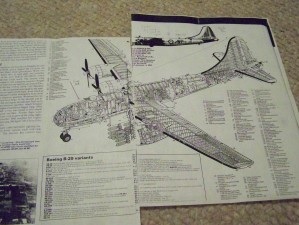
Mr. Broniarczyk: Yes. The B-29 had 11 men. (Mr. Broniarczyk showed the interviewer where he sat in a diagram of he B-29.) The engineer sat in very close quarters. There was a long tunnel through the bomb bays and the wings. A gunner might say to me, “Number two is smoking.” I’d have to crawl through that tunnel. Before I did that, I would have to remove my chute. I always feared that I would be in the center of that tube when we got hit. I could see the engine from the gunner’s position. (Mr. Broniarczyk was probably referring to the top gunner’s position. See the diagram and #22)
Flight Engineer Broniarczyk’s position in the B-29 (21)
Q: When the gunner said “Number two,” was he was referring to the second of four engines?
Mr. Broniarczyk: That’s right.
Q: What kind of engines were on the aircraft?
Mr. Broniarczyk: It was a Wright 3350. A pile of junk.
Note: Early versions of the R-3350 were equipped with carburetors, though it was the poorly designed elbow, or entrance to the supercharger that led to serious problems with inconsistent fuel/air distribution. Near the end of World War II, in late 1944, the system was changed to use direct injection where fuel was injected directly into the combustion chamber. This change improved engine reliability immediately. See: http://en.wikipedia.org/wiki/Wright_R-3350.
Q: Did they ever outfit the plane with a different engine?
Mr. Broniarczyk: When they came out with fuel injection, the engine improved.
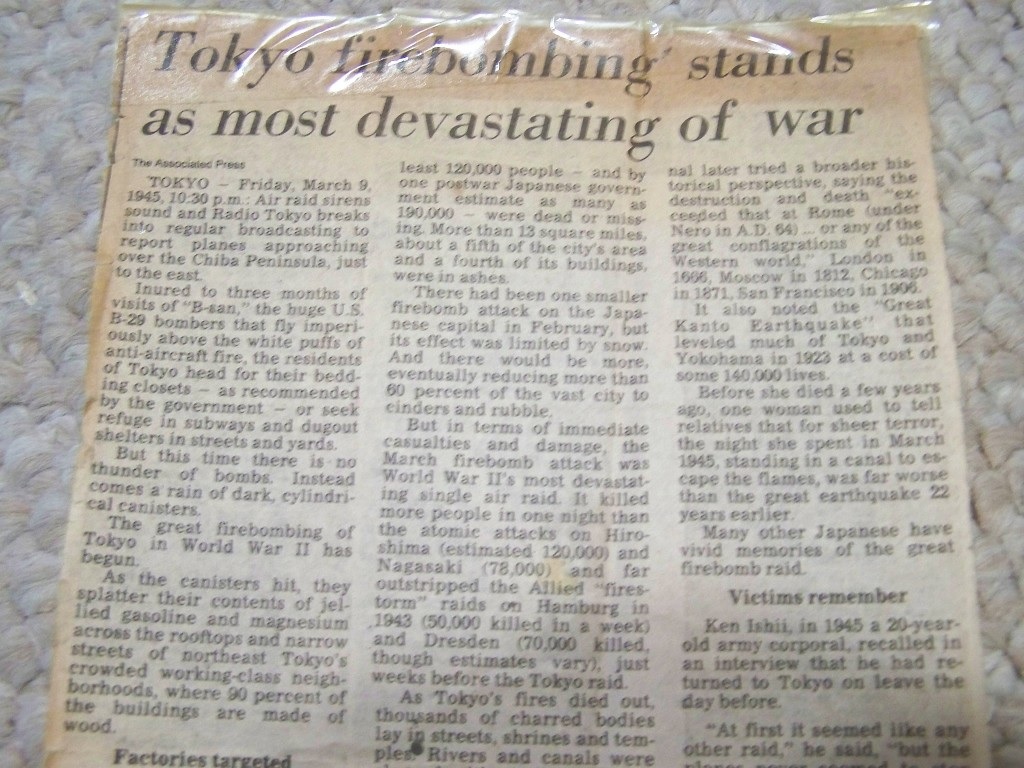
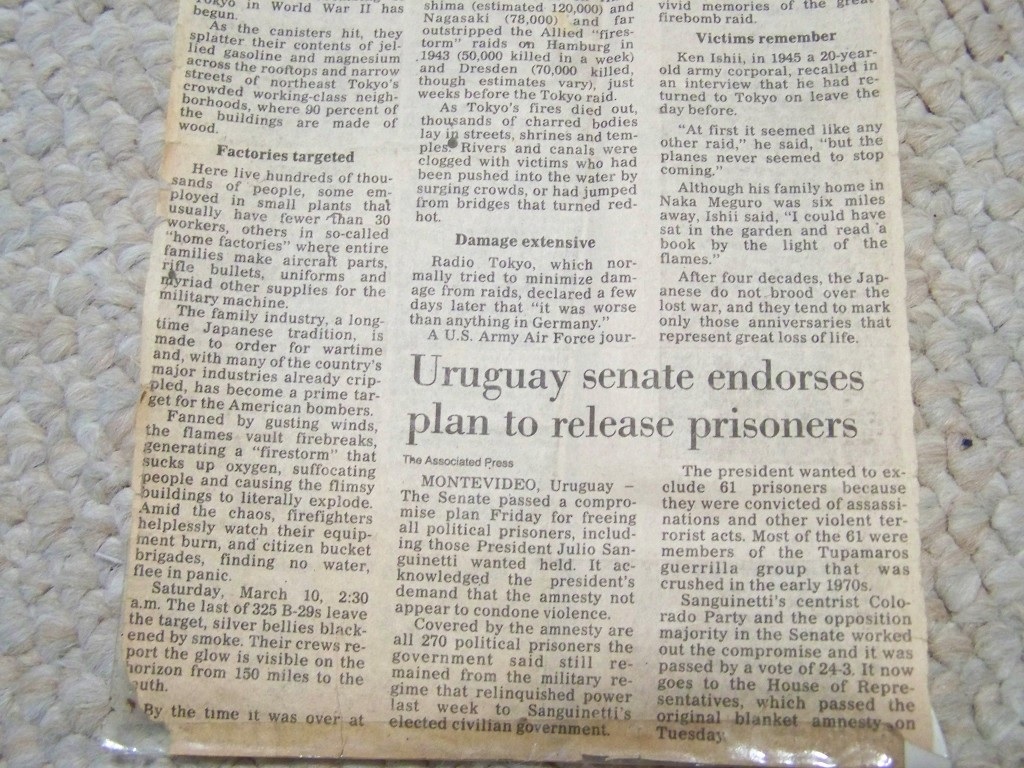
Q: (Mr. Broniarczyk had a newspaper clipping telling the story of a bombing run in which he had taken part.) In this bombing run over Tokyo on March 9th, the one you were involved in, you were in one of these B-29s that had engines that weren’t so good?
An informative news article printed long after the war
Mr. Broniarczyk: That’s right. We lost a lot of airplanes because of engines. When we took off, it was the engineer’s duty to call out the high cylinder head temperature. We had overheating problems.
Q: You had gauges that showed the temperature of each engine?
Mr. Broniarczyk: All of the engine instruments were mine.
Q: How did you communicate with the other crew members? Were you connected by radio to everyone on the plane?
Mr. Broniarczyk: No. The airplane was pressurized. Oxygen was flowing all of the time. It was very comfortable and you could talk to others. The engineer was very near to the pilots.
Q: Who communicated to the bombardier?
Mr. Broniarczyk: (He pointed to the diagram.) They were close to the front.
Q: It looks like the tail-gunner was by himself.
Mr. Broniarczyk: He wouldn’t be at the far back for take-off. Once he was told to take his position, he was in the only unpressurized section of the plane. He had to wear an oxygen mask.
Q: How many missions did you fly?
Mr. Broniarczyk: I don’t remember the total of all of the missions I flew, but I think it was four missions over Japan. Fortunately, I was on what was called a “Pathfinder Mission.” The Japanese didn’t think much of one airplane flying over. The Pathfinder had the top navigator and top bombardier. The rest of the planes would follow after the Pathfinder.
Q: Did we lose our bombers due to anti-aircraft guns or fighters or a combination?
Mr. Broniarczyk: It was a combination. At this point, they didn’t have many fighters remaining.
Q: Did you have escort fighters?
Mr. Broniarczyk: We had P-51s. It was a lot safer at this point in the war because Iwo was behind us. We had to land at Iwo once because our engines weren’t synchronized. Some stray shrapnel hit the prop and knocked it out of balance. I couldn’t control the prop. I cut the engine off and feathered the prop. By “feathering,” I mean that you shape it as an air foil. We landed at Iwo and put on a new prop.
Q: Iwo was taken when you landed there?
P-51 Mustang
Mr. Broniarczyk: It wasn’t taken yet. The marines were fighting there. An airplane from our outfit, Number 8 – “Dynamite” – was the first airplane to land at Iwo. When it landed, it hit a pole and dented the wing but everyone was O.K.
That was about the time I got both of my eardrums busted.
Q: How did that happen?
Mr. Broniarczyk: We had a leak in the pressurization system and we dropped 6,000 feet very quickly.
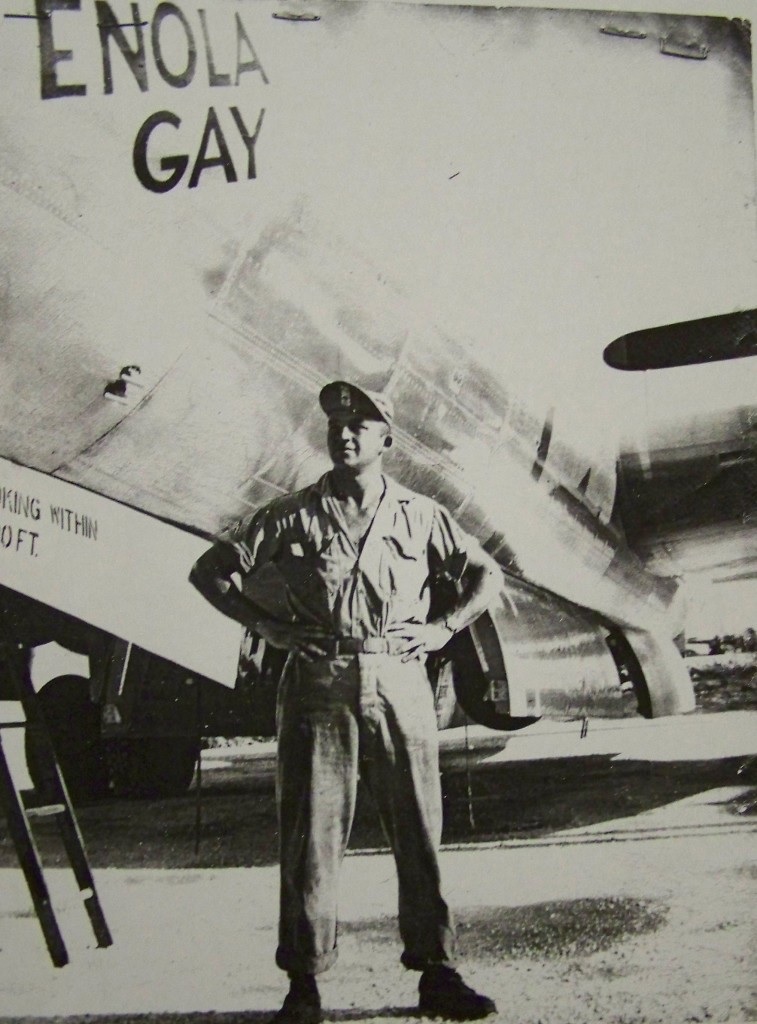
Q: This picture of you with the Enola Gay, how did you get this?
Mr. Broniarczyk: This was taken in August of 1945. The picture was taken on the island of Tinian. A fella came to me and said, “Hey Sarge, the 509th dropped a bomb and wrecked a whole city. I said, “Ah, bologna.” I didn’t believe it. The next day I went over and had this picture taken.
Sergeant Broniarczyk and the Enola Gay, August 7th, 1945
Note: For more on the Hiroshima bombing, see: http://www.cfo.doe.gov/me70/manhattan/hiroshima.htm
Mr. Broniarczyk: At this time, I was relieved from duty because I had 111 points. This represented a lot of time.
Q: Did you say this picture was taken the day after the bomb was dropped?
Mr. Broniarczyk: Yes, it was taken the day after the atomic bomb was dropped on Hiroshima.
Q: How old were you in this picture?
Mr. Broniarczyk: I was born in 1914. I was around 30 years old.
Q: After you completed your time, did you head back to the states?
Mr. Broniarczyk: They didn’t have the planes or the ships to take me back. Naturally, officers got preference. So, they sent me to Saipan to await a ship. They organized us into groups according to our region of the country. They put me in charge of 90 guys going to Chicago.
C130A Cargo Plane
“They put me in charge of 90 guys going to Chicago.”
-Mr. Anton Broniarczyk
Part III
Q: You were the baby sitter.
Mr. Broniarczyk: I had help. I chose a huge African-American sergeant whose name was Mac. I said, “Mac, you’re in charge of the African-Americans. We played baseball and I would assign some of the guys certain duties, but not many. When the ship finally arrived, it was a “Liberty Ship.” It was a scowl. I remember that I was checking the guys off and I asked the minister, “How long will it take to get back to the states?” He said, “If you’re lucky, 23 days. I thought that was a bit long. Our ship arrived at Oakland, California faster than he thought it would. We took a train to Chicago. It took us 21 days to get to Fort Sheridan, which was north of Chicago.
Q: Did you have to keep track of those guys all the way to Chicago?
Mr. Broniarczyk: Yes. We came into Fort Sheridan and the officer got up and said, “Now you’re going to get everything that you didn’t get on the island.” He was talking about the food. They gave us steaks and everything. The German prisoners were there and they were the ones doing the tailor work.
Q: Let’s go back to the B-29s. How many were in the crew and what were their jobs?
Mr. Broniarczyk: There was a crew of 11: the pilot, the co-pilot, the navigator, the bombardier, the engineer, the right gunner, the left gunner, the CFC gunner, tail gunner, and radar operator. If a gunner got shot, the CFC gunner could control any gun on the ship. CFC stood for Central Fire Control.
Q: You were the only man taken off of Captain Black’s crew?
Mr. Broniarczyk: Yes. I was the only person. The guy who replaced me; he haunts me at night. His name was Balecek.
Q: He had a name that was similar in origin to yours.
Mr. Broniarczyk: Yes, he was a short, stocky guy. I picture them coming down. You just can’t get out of the airplane. Centrifugal force holds you in that airplane.
Q: Did they have parachutes?
Mr. Broniarczyk: Yes, the difficulty of getting out depended on where you were hit. You had your choice. When you were in trouble, you could either parachute into the civilians and they’d kill you, or you could try to get captured. The other possibility was a landing in the ocean. Then there was a good chance the sharks would get you.
Q: Not a lot of good choices.
Mr. Broniarczyk: No. If you landed in the water with that B-29, it would stay afloat maybe ½ hour.
Q: Did anyone survive such a landing.
Mr. Broniarczyk: Yes. I took part in what was called a “Dumbo Mission.” It was a mission where the sole purpose was to look for survivors. You were confined to a certain area. That was rough because the flights were 16 to 18 hour flights.
Q: I’m still curious about the number of missions you flew. I know you were in the air quite a lot. I know it had to have been more than 12 missions.
Mr. Broniarczyk: Yes, the Enewetak or Truk flights weren’t considered missions.
_______________________________________
Note: The interviewer forgot to ask what Enewetak was so it was researched.
Truk Lagoon is part of the Federated States of Micronesian, and consists of 11 major islands and many smaller islets within a 40 mile wide lagoon surrounded by a protective reef. Moen is Truk’s capital.
History
Truk was the Japanese “Gibraltar of the Pacific” the seemingly impregnable base for its combined and Fourth Fleets. It was also used as a ferry point for aircraft from factories in Japan to theaters of operation in New Guinea and the Solomons. Five wartime airstrips and seaplane bases were built during the war. For Japanese aircraft, it was an important way point for flights from Japan to other South Seas bases. Aircraft carriers occasionally ferried planes through the Truk strips.
Atoll Defenses
Heavily defended Truk’s defenses were bolstered with additional sub and torpedo nets placed in the water along with more mines and even rocket launchers from Japan. There were over eighty 25mm guns and 12cm guns in emplacements along with many smaller guns. Kaiten units of manned suicide torpedoes were assembled to the outer islands and Daihatsu landing craft were converted into torpedo boats. Mine fields in the passes and lagoon along with beach defenses were the main defenses against possible American invasion.
Surprise Attack: Operation Hailstone
On the morning of February 17, 1944 a surprise United States Navy air attack code named “Operation Hailstone” caught a fleet of Japanese Merchant vessels and warships by surprise in Truk Lagoon. 400 tons of bombs and torpedo rained down on the lightly defended base. After a day of attacks, forty ships and thousands of men went to the bottom. Ten weeks later, a second successful raid added a score more ship to the bottom. For more than two years after the war, oil from the sunken ships covered the beaches and reefs. Truk was strategically bypassed and neutralized by encirclement, island hopping and aerial attack by the USN, 13th AF and 7th AF.
See: http://www.pacificwrecks.com/provinces/truk.html
Enewetak Atoll (or Eniwetok Atoll) is an atoll in the Marshall Islands of the central Pacific Ocean. Its land consists of about 40 small islets totaling less than 6 km², surrounding a lagoon, 80 km (50 mi) in circumference. It is located at 11°30′N 162°20′E / 11.5°N 162.333°E / 11.5; 162.333, making it the second westernmost atoll of the Ralik Chain. It was the site of U.S. atomic tests from 1948 to 1954.
U.S. Military planes were constantly working to keep shipping lanes in this area clear.
We found an example of a Marine bombing squadron patrolling the Enewetok (Alternate spellings include Enewetok or Eniwetok) area in July of 1945. See: http://www.vmb613.com/july_1945.htm.
___________________________________________________
Q: Did you ever count up your total hours in the air?
Mr. Broniarczyk: No.
Q: From where did you leave, and how long did it take to get to Tokyo?
Mr. Broniarczyk: We took off at Tinian, and the trip took about 12 hours.
Q: How long were you stationed at Tinian?
Mr. Broniarczyk: We stayed until November of 1945.
Q: Did any other family members serve in the war?
Mr. Broniarczyk: One brother was in the Combat Engineers over in Europe and Japan. My youngest brother was on convoy duty.
Q: They survived the war?
Mr. Broniarczyk: Yes. Here’s another indication of how unprepared we were. (Mr. Broniardzyk showed the diploma with the word “Army” at the top.)
Q: What did you do when you got out?
Mr. Broniarczyk: I was undecided whether to re-enlist or not. I thought that I might need to take care of my parents.
Q: Did you find a job right away?
Mr. Broniarczyk: No. I jumped around. I worked for my brother. One day I took the day off and went to the Main Post Office in Chicago, looked on the board, and there was a notice that read, “Jet Engine Inspectors Wanted.” The jet engine was new. I was interviewed by a captain and a civilian. “What engines are you familiar with?” they asked. I said, “The 3350, 2800, and the 985. I have no jet engine experience.” They said, “We haven’t any ourselves. Can you start tomorrow?”
I ended up helping to manufacture jet engines; the J-65 in particular. I worked in LaGrange, Illinois on the Wright J-65.
Wright J-65 Jet Engine
Mr. Broniarczyk: Buick. Half of the plant was making cars and half was making engines. These engines were made for military aircraft. GM’s contract ran out and the jet engine side of the plant dwindled down to just a few of us. I think I was the last guy left working there for the government. I had been there about three years.
I wrote up my resume and sent it to Boeing in Seattle. They accepted me. I also sent my resume to Lockheed in Marietta, Georgia. They were making the C-130. I figured that was closer to home. They accepted me so I went down there. I liked it there. I liked the people there. I think at the time it was the largest aircraft plant in the world. I was an engine inspector. Do you know the size of a C-130?
Q: Yes. (See picture at the top of this Part.)
Mr. Broniarczyk: It’s huge. I bet they’re still flying some of the ones we made. It’s the best airplane they ever built. I was there through models A, B, C, and D, etc. There were many modifications through the years. I liked it there. The plant was all government owned. I’d get a whole meal for 50 cents.
Q: It sounds like they took good care of you.
Mr. Broniarczyk: Yes. I was eventually transferred to O’Hare Airport in Chicago. I went to school and became a cost analyst. I worked there until I retired.
Q: At the time of retirement, were you still working for the government or for a privately owned company?
Mr. Broniarczyk: I worked for the government. Most of my work was on items that were paid for by government contracts. A cost analyst dealt with airplane parts, etc.
Q: When did you retire?
Mr. Broniarczyk: It was sometime in the late 1960’s.
Q: We live in a completely different world today.
Mr. Broniarczyk: You’re tellin’ me.
Q: What happened?
Mr. Broniarczyk: People take liberty for granted. They take freedom for granted. That’s what it is. My father used to tell me, “They don’t know what freedom really means.” He lived under German and Russian rule.
Q: From where did your Father immigrate?
Mr. Broniarczyk: He came from Poland. At the time, what is now Poland was divided into Austria, Germany, and Russia.
The World that Mr. Broniarczyk’s Father Knew as a Child
Q: He was raised in a communist country?
Mr. Broniarczyk: Yes.
Q: How old was he when he came to America?
Mr. Broniarczyk: I think he was about 22. He said good-bye to his mother and swam across the river. The Russians and Germans patrolled the river. The Warta River was the dividing line between the two countries.
The Warta River Today
Mrs. Broniarczyk: Please print this. (She handed the “Wings” reporter a small piece of paper that contained a statement.)
Mrs. Broniarczyk’s Note
Mrs. Broniarczyk: In 1899, my father joined the American forces and fought in the Spanish/American War. He went to the Philippines. He was a member of the cavalry.
Q: He was with Teddy Roosevelt?
Mrs. Broniarczyk: Yes. When they came they back, they were greeted by the father of General McArthur. In 1958, I took my two grand nephews to the Presidio in San Francisco. We drove all the way to California. I took my father back to see the place where he had returned from the war. He joined because he came to the United States at the age of 8.
Q: From where did he come?
Mrs. Broniarczyk: Poland.
Q: Both of your families are from Poland?
Mrs. Broniarczyk: Yes. My father was eight years old when his step-mother brought him over with his brother. It wasn’t until 1926 that he became a citizen of the U.S.
Q: Why did it take so long?
Mrs. Broniarczyk: I don’t know. He never went to school.
Q: Mr. Broniarczyk, did your grandmother make your father swim that river?
Mr. Broniarczyk: Yes. The Russians had a man on horseback patrolling the border. The Germans patrolled the other side. The Germans didn’t care if the Polish crossed the river because the Poles were good workers and they needed workers at the time. The Russians, however, subjugated the Poles.
Q: How did your father make it to America?
Mr. Broniarczyk: He had some relatives in Germany. He stayed with them until he had enough money to come to this country. The story that I heard was that it took the freighter 18 days to get here.
Q: Did he come through Ellis Island?
Mr. Broniarczyk: Yes. When he arrived, he had a lot of cold sores and he was afraid he wouldn’t be accepted.
Ellis Island Around the Time Mr. Broniarczyk’s Father Arrived
Q: I know that many names got changed or shortened at Ellis Island. Yours didn’t. Why?
Mr. Broniarczyk: The original Polish name was Bronis.
Mrs. Broniarczyk: In Poland they changed their names so that the Russians wouldn’t take their kids into the service.
Q: They wanted the names to look more Polish?
Mr. Broniarczyk: There was no Poland. We lived under Russian rule. The area eventually became Poland.
Q: You mentioned that when you joined the service that your parents had it rough. Your father had tuberculosis. How did he make his living?
Mr. Broniarczyk: He worked in an enamel factory.
Q: Your mom was a homemaker?
Mr. Broniarczyk: Yes.
Q: How many children were in the family?
Mr. Broniarczyk: There were four of us: my sister, me, my brother Frank, and my brother Eddie.
Q: What was your sister’s name?
Mr. Broniarczyk: Her name was Cecelia. My father married an American and she taught him English.
(At this point, the 2 hour limit on the recorder ran out. The remainder of the interview is taken from notes.)
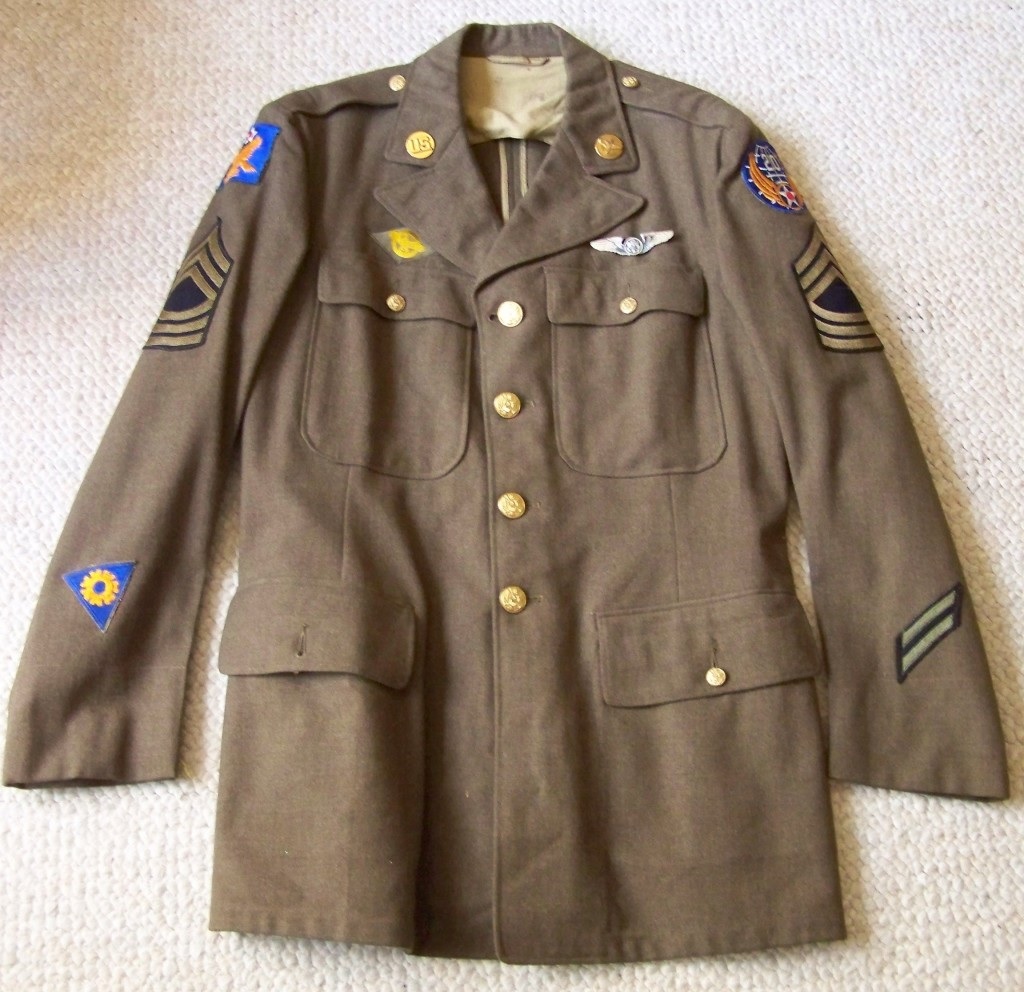
Q: What do some of the symbols on your uniform represent?
Tech Sergeant Broniarczyk’s WWII Uniform
Mr. Broniarczyk: The stripes mean that I eventually earned Tech Sergeant. The wings mean that I was a flight engineer. The two bars on the lower left sleeve mean that I was in for two 3-year hitches. I was in for a total of six years and ten days.
Q: What would your father say about Americans today?
Mr. Broniarczyk: He would say that the average American hasn’t the slightest idea of what freedom is.
Q: Thank you for spending so much time with me.
Mr. Broniarczyk: You’re welcome.
A VETERAN SPEAKS – PART VI
Q: What would your father say about Americans today?
Mr. Broniarczyk (pronounced Brawn-r-chick): He would say that the average American hasn’t the slightest idea of what freedom is.
This statement, by a man who is almost twice my age, made me think. I could never appreciate freedom like Mr. Broniarczyk’s father, because I’ve never experienced what he did as a young man in Russia in the late 19th century. I am thankful for my freedoms and I don’t respect Mr. Broniarczyk just because he’s older than I.
Honestly, I’ve come to understand that there are many of my elders who lack wisdom. An example: Mr. Dingell standing up in the House of Representatives and making a statement defending a document that is socialistic in nature. He was the final speaker used in an attempt to prop up a health care plan that would make us less free. Mr. Dingell is representative of many of today’s “elders.”
I was taught to respect my elders, but I hope I would have the strength to do the same thing that Mr. Broniarczyk’s father did, if necessary. I hope that I could run from misguided elders because of an opportunity at freedoms never experienced, even if it meant that I would probably never see my mother again. This would take courage and, probably, prompting. My life is more than half over. I will face other challenges.
Anyone who read this three part series, or any part of it, should be able to sense my love of history. I like history because it is the story of how people react in situations. It’s about real world reactions. It’s tells of valor, and it displays the sinful nature of man. It is a reflection of the best and the worst. In it are lessons to be learned. I’ve come to understand that without experience, it is difficult to learn lessons. Nevertheless, the lessons are there. In the end, history is about people, not just a bunch of dates on a piece of paper.
Besides being “living and active and sharper than any two-edged sword, and piercing as far as the division of soul and spirit, of both joints and marrow, and able to judge the thoughts and intentions of the heart,” the Word of God is history. In it is found the most important historic event. It is a deed that presents redemption to mankind. The Word of God or “manual for life,” as Dr. Baugh would call it, is being removed from every area upon which daylight falls. This is a story in itself. It’s a lesson in history, if you will, and a sad one at that.
I know very little about Mr. Broniarczyk’s father. I know more about Mr. Dingell’s father thanks to the internet. Some may say that I can’t make a good comparison due to a lack of equal information. After reading a short summary of John Dingell Sr., I can only make a judgment based on the information at hand. Some may question, “I thought we were not supposed to judge others?” You may look at this blog out of curiosity or you may like a certain thing you find here. There are many reasons that people join a choir.
I am acutely aware of the scripture, “Do not judge, lest you be judged yourselves (Matthew 7:1).” This scripture is found in one of my best loved sections of God’s Word. It is the greatest sermon ever preached in the history of the world. It is called The Sermon on the Mount. It would do well for all to learn the verses that follow the first verse of Matthew, chapter 7. At the root is the real question: Are we right with God? Before we can truly make perfect judgments, we have to perfectly understand God’s Word. Who can claim they have such understanding? Yet, we daily make, and must make, judgments about small and large things. I believe “apart from God we can do nothing.” These are the words of Jesus, not the words of a faulty man among the masses. We are going to be judged and we must make judgments. Jesus said, “in the way you judge, you will be judged; and by your standard of measure, it shall be measured to you.” The question that is at the heart of God’s Word is: “Are we right with God?”
The answer can only be given in the affirmative if there is an understanding of a simple truth. Jesus said that “unless you are converted and become like children, you shall not enter the kingdom of heaven.” He said this when, the disciples, of all people, were arguing over who was the “greatest in the kingdom of heaven.”
The simple truth is reflected throughout the Word of God. It is the truth of unconditional love. God loves us in spite of ourselves. He is waiting with open arms. All we have to do is surrender. Our culture has trained us that this surrender can happen in one night, at one crusade, in one prayer. The Bible shows the opposite. Peter is a great example. In Matthew 16:16, Peter recognizes Jesus as the Christ, and receives one of the highest compliments a human is ever given. It must be noted that Peter doesn’t get the credit, however. “Flesh and blood did not reveal this to you, but My Father who is in heaven,” Jesus explained.
It is only seven verses later (Matthew 16:23) that Jesus says to Peter, “Get behind me Satan! You are a stumbling block to Me; for you are not setting your mind on God’s interests, but man’s.”
What’s the point? Christianity is a lifelong, learning, Holy Spirit induced experience. It’s not a one-night whammy, where all is made right in a single moment and we are at the height of our experience with God at that moment. This belief is what has had such a negative impact on faith in our culture. Thousands of people have marched to an alter and have been told that all is well. They are told that they are at the end instead of at the beginning. They are told that their sins are forgiven, a truth for the moment if they are sincere. There is another side to the coin, as the good pastor Mark Cain would say. This acknowledgement of sin doesn’t end with one prayer.
If we are aware of our true condition, we know that we are no better than Peter. How can we be? Jesus said of Peter, “upon this rock I will build my church.” After we say the first prayer of repentance, we are going to find out that we really haven’t changed that much. It is only because of God’s patience with us, the fact that he will never leave us or forsake us, that we begin to stumble in the correct direction. The reason is an unconditional love that we will never completely understand this side of heaven. Our eyes come off of Him, and we sink over and over.
The Christian’s experience is no different than Peter’s or Moses’. We fail again and again. The thing that keeps us on the narrow path is the same thing that saves us. It is the work of God, the shed blood of the perfect Lamb, not our works. This is what sets Christianity apart from all other “religions.” Others must earn their salvation. Ours is by grace.
We must say that first prayer. It is a big moment. Many remember the moment as I do. It is only a big moment because it is the first moment. We start as a lump of clay. That’s where we are at the first prayer. Between our first and last prayers there is a greater understanding of how much of a lump we are. That’s how the pot is formed.
So, what does all of this have to do with Mr. Broniarczyk’s father and John Dingell Sr.? I think it has a lot to do with them. The key word is freedom. Mr. Broniarczyk’s father understood freedom because it was something he didn’t have and hoped to gain. Isn’t this really what all humans are looking for…true freedom? A Christian understands that true freedom can be found in Christ alone.
Martin Luther’s understanding of this truth started a reformation.
Why has America’s experience been, arguably, the greatest occurrence of freedom since the creation of the universe? The answer lies in the beliefs of those who put this experiment together. Yes, a few of the smart ones were Deists. One of them was egotistical enough to write his own version of the Bible. He took out the miracles, among other things. He must have thought them not possible.
The majority, however, understood something of the grace of God. They understood the importance of the Word of God. Read their letters. Read their speeches. Note their actions. You could easily compile a complete Bible from their words. They would be embarrassed if they had twice read their Bibles. The embarrassment wouldn’t come from the admission of such a deed to a secular world. The embarrassment would come from the admission of lack of study to a group of men who knew the Word of God well.
______________________
“In January 1995, John Dingell, Jr. became the Dean, or the longest-serving member of the House and, as of 2009, the father and son together have 76 consecutive years of service in Congress.
A hallmark of their service has been a proposal for a national health insurance system, first introduced by John, Sr. in 1933 and re-introduced since at every Congress by the father and then the son.
John David Dingell, Sr. (February 2, 1894, Detroit, Michigan – September 19, 1955, Washington, D.C.) was an American politician who represented Michigan’s 15th congressional district from 1933 to 1955.
Dingell was born in Detroit and worked as a newsboy, printer and newspaperman. He had also engaged in the construction of natural gas pipelines, was a wholesale dealer in beef and pork products and an organizer and trustee of Colorado Springs Labor College.”
____________________________
This entry is from Wikipedia. Personally, I wouldn’t have used the word “hallmark.” Nonetheless, the fact that Mr. Dingell worked in the news business makes me think kindly of him. On the other hand, I know enough about the media of the past and the present to know that an affiliation with “news” doesn’t give one a “get out of jail free” card. The majority of Today’s media is untrustworthy.
I will not judge the destiny of any soul. This is God’s job. I do know that Mr. Dingell’s internment at the Holy Sepulcher Mausoleum in Southfield, Michigan will not guarantee his salvation.
I do not hold an unfavorable view of John Dingell Sr. because of the following additional excerpt from Wikipedia:
“Reflecting the prevailing prejudices of the period, a memorable letter from Dingell to President Franklin D. Roosevelt on August 18, 1941 suggested that ten thousand Japanese-Hawaiian Americans be incarcerated in order to ensure ‘good behavior’ from Japan.”
I think God would be as forgiving as the Wikipedia entry if an acknowledgement of error had been issued. I’d guess that Mr. Dingell made such an concession.
Anyone who started as a newsboy deserves a good look. It denotes a work ethic. This is a good thing. From where does the “Protestant Work Ethic” come? It comes from the scriptures. If you don’t work, you don’t eat. An atheist would argue that many well-fed folks don’t work a lick. I would reply that their food is that of the worldly kind.
Why pick on the Dingells? I’m very limited on what I can write about the father. But the son is pushing a law that would give a huge amount of power to a man who has not been placed in office by the people. The man I’m referring to is the one created in the health care legislation that is heading for the Senate of the United States of America. One man, some call him a Czar, would make important decisions about the nation’s health care. The man would be appointed by the President.
I do not want one man, Republican, Democrat, or otherwise, deciding for me if I am to live or die. That is God’s job. To give an unelected official that kind of power goes against every intention of our Constitution. The godly men who framed our Constitution understood the sinfulness of man. Thus, the checks and balances between the branches of government. To give one, unelected man this kind of power takes freedom from the people. It seems that there are a great number of Americans who don’t understand this. I think that Mr. Broniarczyk’s father was right. He was right because most of us have not experienced the oppression of a socialist regime.
It is not surprising to me that our country is considering laws that are socialistic in nature. Socialism is based in godlessness. As our laws force us to remove the words that made this country great from the walls of our important buildings, including our schools, we will continue to decline in every way. The words that made this country great were God’s words. The words that made this land the most blessed experience in freedom are being put away.
We can blame our leaders and politicians. They aren’t the problem. The problem is with the “Christians.” When churches accept or remain silent on subjects that are clearly defined as sin, then the church has ceased to be salt and light. Whose fault was it that prayer was removed from our schools? Whose fault was it that abortion was legalized? Whose fault is it the homosexuality is becoming an acceptable lifestyle? It wouldn’t have taken 100%. It wouldn’t have taken 90%. It wouldn’t have taken 80%. Honestly, I don’t know the percent required, but if those who call themselves “Christian” had taken a stand on issues like these, God’s laws wouldn’t be coming off of our walls. It started when the commandments of God started coming off of church walls.
If you are this far into the ride, I’m going to now try and express my thoughts about a main subject in this series: war. It must be stated at the start that I will never understand a man like General Patton. I’ve read that he loved war. Supposedly, the historians write, he was restless unless he was in the heat of battle. It is obvious that God can use a man like Patton. Many German leaders didn’t fear God but they feared Patton. Another example of an unlikely warrior who was used of God is Nebuchadnezzar, the king of Babylon.
I must admit that I am not like these men. I am near the opposite end. I have generally tried to avoid conflict.
How is a Christian supposed to view war? There have been thick books written on the subject. I’ll try to do it in less than a page so that you don’t decide to do what most do with those lengthy books.
I’ll start with a Pixar film.
Some of you have seen the animated movie entitled “The Incredibles.” If you haven’t, I want to share one scene with you. Here’s a quick set-up:
Mr. Incredible and the other superheroes, called “supers,” are no longer allowed to use their abilities to stop crimes. Why? Well, Mr. Incredible saved a man who tried to commit suicide. In stopping the man’s leap off of a high building, Mr. Incredible supposedly injured the man’s neck. Instead of the warranted appreciation for saving the man’s life, Mr. Incredible was sued. He hadn’t allowed the man to end his pain. The government is involved in the situation and shuts down the supers.
Here’s the scene. Mr. Incredible has become an insurance salesman. He hates his job. Picture a huge guy standing in an office with a tiny boss screaming at him for being honest, hurting the company’s bottom line as a result. While the boss is jumping up and down, Mr. Incredible spots a mugging going on outside. Every impulse in him wants to help the person in need. The boss threatens to fire him if he leaves to help. The mugger gets away. Those of you who have seen the entertaining movie know that Mr. Incredible doesn’t handle the fact that he’s been scared by his boss very well.
The right thing to do is to help those in need. When we see others mistreated, we should help. We often don’t because it is inconvenient, time consuming, or costly. We aren’t God and we have limitations. There are times, however, when we are capable of intervening and for whatever reason, we don’t.
In 1939, Germany invaded Poland. For a short synopsis, see: http://www.ushmm.org/wlc/article.php?ModuleId=10005070. The last time I walked through a public school, there were signs in strategic places that said, “No bullying allowed!” Hitler was the bully on the block in 1939. Some folks had seen it coming, but few did anything to stop him. Hitler had planned it all very well. The poor Poles didn’t fight because they knew they would be massacred. Those who had promised help were nowhere to be found.
I asked a veteran of the Vietnam War about WWII. Interestingly, I just met him today. “What would have happened if we hadn’t responded by bombing Pearl Harbor?” I asked. “We would be speaking another language,” was his answer.
I haven’t agreed with certain things our military has done over the years. But, I have the same question that my new friend asked me today. Did Japan ever pay money to the families of those who died at Pearl Harbor? The United States helped rebuild Europe and helped spread the ideas of Freedom in the post WWII years and now people are asking us to make payments to the families of civilians that were killed.
I hate war. I don’t like it one bit when civilians are killed. War is necessary for the same reason that the Constitutional balances of powers are necessary: if bullies are not restrained, there will be tyrannical rule and, in today’s world, the possibility of something much worse.
I know the Sermon on the Mount well. I know the “turn the other cheek” verse. I am also aware of the story of the Good Samaritan and the anticipated return of Jesus Christ. The first was an illustration to teach us what to do when others are in need. The second is not going to be a peaceful event. The scriptures are in perfect balance. For each verse, there is a counter verse. To rightly divide the Word of God involves study. I’ll be the first to admit that I don’t know the only living document (in spite of what they say about our country’s founding statements) as well as I should.
The Revolutionary War was supported and fought by men who had prayed for years for a peaceful resolution to tyranny. The bully kept turning up the heat.
There is a situation in the world today that is much worse than the one those in the colonies faced in the late 18th century. There is a free nation in the Middle East that has been threatened with extinction. It is a nation that has existed since 1948. Actually, it’s the oldest nation on earth. It was scattered for centuries. A nearby “neighbor” is working on a bomb that can destroy the little nation that espouses freedom. The bully is very close to having the devastating weapon. What is the little nation to do? If it does nothing, there is a chance that everyone in the country will die. Other nations have put pressure on the bully. The bully continues to plot the destruction of the little country. If it was your family, and you had the capability to stop the bully from the inevitable, what would you do? Wouldn’t it be better for even the folks in the bully’s own nation if he were stopped before bombs started falling?
I do have some good news. The bully will not kill all of the people in the small country. How do I know this? Prophets who have thus far been correct 100% of the time have written so.
“There is an appointed time for everything. And there is a time for every event under heaven-
A time to give birth, and a time to die;
A time to plant, and a time to uproot what is planted.
A time to kill, and a time to heal;
A time to tear down, and a time to build up.
A time to weep, and a time to laugh;
A time to mourn, and a time to dance.”
The interview with Mr. Broniarczyk was a wonderful experience. The memory of the 95 year old gentleman was impressive. Granted, some of the subject matter wasn’t pleasant. War is not a pleasant thing. I’ve found that most men who’ve experienced true war don’t want to talk about it. As I talked with Mr. Broniarczyk, he smiled a lot. He wasn’t smiling about the war. He was smiling about the fond memories of the dedicated and humble people he had met during his war experience. He spoke mostly of the people he met. He mentioned dropping bombs once that I can recall, and he did so with caution.
War is a horrible thing. We should teach this to our children. We should also teach our children about the price that’s been paid for the freedoms that we enjoy. They should know about the people who have paid that price. If we don’t teach them, who will? We can’t leave it to the schools. There are things in our history books that would make the most hardened soldier angry.
Does the average American citizen know the difference between self-determination and despotism? I would have to agree with Mr. Broniarczyk’s father. We’ve been living in a dream too long. If we don’t wake up soon, we’ll be living in a society similar to the one from which Mr. Broniarczyk’s father ran.
Chris Reimers


 Posted by Chris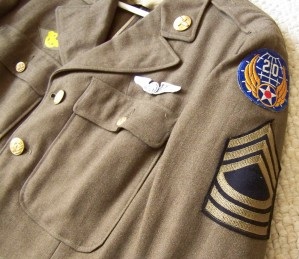


 Wings of the Wind
THE RISE AND FALL (?) OF THE NORWEGIAN CPS
June 7, 2016by Elsa Christensen
Part 1
It is Ascension day, Thursday the fifth of May, 2016. A mother walks through the gates of Vilde “Home for Mothers,” never to return. She takes her son with her, a boy of about five months. The next days will be the first days that the mother and the baby get to be together without any public surveillance in a governmental institution, surveillance by the CPS.
Mother and child had survived five months away from home, observed day and night in an institution with video surveillance. Their performance of day-to-day tasks had been continuously monitored. In addition, daily notation of facial expressions, mood, and development were recorded. And then there was the IQ testing.
Why was this Mother’s freedom to be in a normal social setting taken from her? When she was thirteen years old she was at school with her twelve year old sister. The authorities came in with the CPS and forcefully separated the two sisters who tried desperately to hold on to one another. The police also took their three other siblings.
“I was fine when I lived at home,” the mother remembers.
From that day, the five siblings never lived together, nor did they get to live with their parents as youngsters. The siblings were spread out, and the girl of thirteen was forced to live in a CPS institution. The other children in the institution were experimenting with several kinds of drugs. The loss of everything that was familiar to her made her seek consolation in the drugs she was offered. Her addiction followed her the next thirteen years. Then she got pregnant.
The day after giving birth to a son on December 1, 2015, it was explained to the mother that the CPS could help. She was told this because the goal was to remove her child from her. This fact was hidden from the mother.
Proposal of Help #1: Two CPS employees came to see her the day after she gave birth. They told her that the child was going to be moved to a foster home.
Proposal of Help#2: On the same day, the CPS promised the mother that they would not take the child if she agreed to admit herself for observation at the Sudmanske “Home for Mothers” in Bergen, Norway.
The mother accepted the “help;” she had no choice if she wanted to keep her boy. Most people would call this coercion. The CPS called it “voluntary acceptance of help.” After approximately a week in the hospital, the mother and child were moved to Sudmanske.
Proposal of Help #3: About two weeks later, two days before Christmas at midnight, the institution staff met with the mother. Instead of the expected discussion of her progress, she was informed that her son would be taken from her as a part of the third proposal of help. Up to this point, she had been breast feeding the boy.
The mother felt powerless after losing her living child, and she did not know where the CPS had taken him. She knew that the boy was taken from the person he belonged to and was a part of.
Proposal of Help #4: About five weeks after the baby was born, the mother was offered another proposal of help. The little boy would be returned to her immediately if she voluntary admitted herself for observation in the Vilde “Home for Mothers” in Horton, Norway. The coercive “offer” was accepted, the baby boy was returned, and the move was made to Vilde. The Norwegian CPS once again called it a “voluntary acceptance of a proposal for help.”
The Vilde “Mothers’ Home” is approximately 500 kilometers from the mother’s home in Bergen.
After four months of continuous observation at Vilde, the mother ended the fourth help proposal on her own initiative on the fifth of May.
*
For many decades, up until the 1970’s, children of wanderers such as gypsies, were taken by force from their parents. The CPS was assisted by the police to give these children what the government said they needed: a childhood without parents and siblings. They would be housed in institutions. Between 25% to 33% of gypsie children born between 1900 and 1960 were treated this way. Girls were IQ tested and sterilized. This was also done to some boys. In addition, whole families were interned in labor colonies. There, among other things, they were taught a “regular life characterized by tough discipline.” This was said to be “voluntary,” but clear threats to take away their children gave parents no choice but to except this existence.
“This is our near history. The last labor colony was closed in 1989. The last sterilizing was done in 1964. Later on, the government had to pay compensation for the abuse, and asked for forgiveness for destroying lives.” (Nina E. Tveter)
Does the mindset behind these actions live on?
Twenty-four years after the last forced sterilization in Molde, Norway, and about the same time as they closed Svanviken labor colony in Nordmøre, the social worker Kari Killén wrote a Doctoral Thesis. It was this work that made it possible for CPS to become as it is today.
After a study of only 17 children, Killen shaped the future CPS, a CPS based on measures of the parents’ functions. Killén told the social workers to evaluate “which parents can help children to survive!” (Molde, Norway, 19.02.2009)
The social workers in Norway and Scandinavia took her grand mission very seriously, and the results of their evaluations are catastrophic. The CPS and the police are now forcing 4-5 children each day out of their homes, most of them never to return to their parents. Last year this “protection” of Norwegian children cost the government 20 billion NOK.
The Middle Class Emotional Neglect
Killén, a social worker, is responsible for an important part of the curriculum for people studying to become social workers, and she has been teaching these courses for years. According to Kari Killén, 45% of Norwegian children suffer from emotional neglect. Her thinking is the foundation for the Norwegian CPS today: that 45% of our children will be traumatized by their own parents because of dubious bonding. When this happens, the CPS needs to “assist” people. Killén’s conclusion is based on this assertion: 45% of our children have parents that cannot help them survive without damage!
Killén argues that the percentage is so high because of a new type of neglect that she calls: “The emotional neglect in the middle class.” This is something that only some of the highly educated can understand: some health nurses, doctors and others may discover it from the time of the pregnancy.
Killen says that “Middle Class Emotional Neglect” is hard to discover and the damage does not show until the child is three to five years old, and particularly in the teen years.
A National Breakdown?
If there is any truth to Killén’s assumption, it would be a sign of a total breakdown of the Norwegian welfare state. Of course, this idea makes no sense and the result of the work that the CPS has done based upon it must be seen as one of the greatest tragedies of our time.
A Forced Stay in a “Home for Mothers”
It wasn’t that long ago that gypsies had the choice between moving to a labor colony, or losing their children and getting sterilized. Today, hundreds of women yearly get the choice between moving to “Homes for Mothers” for observation, or losing their children at once. Just like the gypsies before them, these “choices” are called “voluntary.” We find this enforced in the CPS statistics under the term “help.”
In our culture, women with newborns have traditionally been well cared for. They get help in the house, food served in bed, helpful advice on breast feeding, and care from women that are friends. In the institutions, the women are merely being observed! They are taken away and isolated from their friends and family, people with whom it is natural to share the joy over the baby.
Many women in these institutions tell stories of how they initially got a warm welcome so it was natural to open up and talk about themselves. Then the illegal video surveillance started and there were demands for detailed plans of their daily tasks. The requirement: their plans had to be noted every half hour. Any supervision and guidance came mostly in the form of negative criticism. Monitoring of the voice, facial expressions, hygiene, and lack of initiative were recorded. Finally, the lack of eye contact with the child and other signs of supposed lack of interaction were seriously considered. The things the mothers told about themselves in confidence at the beginning of their stay, was written in an “end report” that was unrecognizable to the mothers themselves.
“End reports” on the different mothers are strangely similar. Many mothers are in despair, often there with their first child. They have “let themselves” be institutionalized by force in a desperate hope of getting to keep their baby or of not losing it again. Most of them do not return home with their children.
The mother mentioned earlier in this narrative survived five months under observations just like these. Every time a child was taken, she remembered when her own baby was taken from her at three weeks of age. She cried every time a child disappeared. In her “end report,” her crying was interpreted this way: “the mother is unstable!” She had lost once and was afraid to lose again.
“End reports” from ” “Home for Mothers”
The “end reports” from “Home for Mothers” are the most depressing literature I have read during my study of the CPS. The heartless lack of concern that make their methods possible are reflected in written observations. A family therapist will deliver these “end reports” to be used by the Council Committee and judges, who need proof for decisions. The “end reports” have a huge impact on the lives of children, parents and whole families.
As noted earlier, the reports are strangely similar. Most things are interpreted in the worst possible way. They are full of symbols, meaning no direct accusations, that describe irrelevant circumstances. Circumstances that, if they were relevant, would discredit the parent and strengthen the therapist’s allegations. Just as enlightening as the things in the report are the things that are withheld on purpose.
In the report above of the woman who moved out voluntarily, breast feeding was mentioned as something she wanted to do, but it was not mentioned as something that she actually did. The fact that she was breast feeding the child until the CPS placed the boy with strangers is deliberately withheld! They did not mention that when the mother got her boy back in her arms after two weeks, her breasts were still not completely dry. They withheld the fact that the mother asked the public health nurse and the doctor in “The Mothers Home” if they thought that she could get the milk production back up, so she could continue breast feeding. They told her she couldn’t! Others knew that she could have managed it easily with some help and in a safe environment. A family therapist described the lack of eye contact between mother and child. She didn’t mention that the CPS kept them from developing the natural eye contact that breast feeding gives, and didn’t mention that they had the mother believing that she could never have this “free” eye contact again with the boy. (A baby’s eye sight is sharpest in the distance from the breast to the mothers face.) Another important fact that was held back was that the mother and child that they observed had just been reunited! The baby came from a two week stay in an emotional no-man’s-land (two weeks, in a lifetime of five weeks). The mother was scared and felt that she was in a dangerous situation after having lost her baby, having it back, and then being threatened of losing it again. The family therapist did not mention that the observations were made in the light of this dramatic break in the relationship between the mother and the baby.
Killén teaches that the people who do not have the necessary caring skills, will probably never learn them. This explains why the “Home for Mothers” is the exact opposite of what is normal in the rest of society. The “Home” does not give help when needed. They do nothing to strengthen and support people who are managing the best they can. These “Homes” merely observe and call it “help.” In reality, they are “helping” the child be torn from where it belongs.
The CPS in the Future
We know a lot about some groups of people in the government who would like to control family activity. Recently, a member of the parliament and social committee suggested that the CPS should start to prepare when the woman is pregnant. The CPS seems to listen to this member.
How many groups of people should be deemed unworthy of the parenting role? The gypsies were told clearly in their time to stop giving birth or be sterilized. Many people who have been involved with the CPS say that sterilization would almost have been better, (because then we would have known for sure that we don´t have a future in our own country.)
Time may be short before claims for compensation will come from the survivors who had their lives ruined by the CPS. It appears that it will be a tough battle. Until then, the CPS will use money from the 20 billion NOK they have at their disposal, for a very peculiar purpose; forcing CPS employees into the homes of families to restore the good impression of the CPS! The ones that are coerced to accept this “help” become traumatized families, in numerous cases, they may get their children back only after long battles with the CPS. As stated earlier, in many cases, they never get their children back.
***************************************************************
The true author of this real life story is Margaret Hennum. (She has been given the pseudonym Elsa Christensen in the article above.) Her identity became known when baby Caspian, was taken from his mother, Nadia, for no good reason whatsoever. Margaret was attempting to help Nadia and Caspian prepare for a normal life (something a good Samaritan would do). Margaret gave a speech at a demonstration against the Norwegian CPS only weeks before her world was rudely interrupted by the CPS. They came to her house and took Caspian on June 13th, 2016.
Speech held at the demonstration in Oslo May 5th, 2016
My name is Margaret Hennum. I am a pediatric nurse and have been working with children and with families in crisis almost my entire adult life. I am a mother of two, but I have never been involved with the Norwegian Child Protection service (CPS), “barnevernet”. So why am I standing here now?
Well, eight years ago I read a book called “Power abuse and miscarriage of justice” by Berit Aarset, a grandmother writing about how the CPS took away the healthy and sound one-year-old from the mother.
I, who hardly ever thought about the CPS before, got a wake up call, and couldn’t NOT stand her. After I read the book, I have heard of an alarming number of parents with similar stories. And I have seen that the Child Protection Service, with the word “protection” in their name, is not a protector, but have become a large threat to our children’s lives and well being!
The CPS has as an official goal to remove more and more children from their homes, and they do. But it is not the neglected children they take. Most of them are healthy, functioning children without any signs of neglect. “This can’t be true,” you say, “there must be something more, right?” Yes, there kind of is, but not in the way you would think. For the CPS thinks they are capable of judging who is able to raise a child and who is not. So even if the children are OK living with their parents right now, they mean to see the parents as a threat to the children in the future. Then they suddenly remove the child without warning, and thereby inflicts the child’s loss of parents, loss of siblings, loss of grandparents, friends and all what they belong to!
It is more than 50 years since health care realized that the parents should come with when children were hospitalized. They understood that the anger, despair and in the end the apathy the children showed, laying alone in the hospital bed, were reactions to loss, natural reactions to the loss of their parents. Now, 50 years later the CPS are taking more and more children from their families, and the child protectors are proud of it!
In the Ida case, the newspaper Stavanger Aftenblad presented recently, we can read about a girl who got aggressive only after the CPS got involved. Many times the CPS describes the children they have removed from their parents as aggressive, despairing and depressed. Lawyer Sverre Kvilhaug says that in all the cases he has been working, he has NEVER seen that the CPS has considered the possibility that they themselves could have created aggressive, despairing and depressed children; these natural reactions to loss of family.
Homeless, yearning and insecure children become damaged children. They are put back in development and prevented from having a normal and healthy development. The CPS, who are making more and more of this homeless children, can not know what it means to belong!
For decades they have gone out to other institutions, like health centres, schools, hospitals and the government agency for children, youth and families, in addition to children and teen organizations, asking them to come to the CPS if they have any worries about a child. Many people have done this, and are shocked when the CPS then immediately empties the home of children.
Last year barnevernet spent 20 billion Norwegian kroner! So, of course, we now have to ask the question: what went so terribly wrong? The barnevernmentor Kari Killén has told her students since 1988 that 45%, nearly half the amount of all Norwegian children, have parents not able to bring up their kids without the help and advice from barnevernet!
If this was not a huge lie, it would imply a total collapse of our welfare society model! But even worse than the billions of kroner spent, are the sufferings of all the devastated families involved. Still the CPS wants more money. But they should not have it; instead their budget will be squeezed. And their only responsibility that will be left for them, are for those severely neglected children, these who are let down by the CPS today. We do not accept that the CPS can be an intruder in the lives of normal, functioning families. The help that normal families need from the government are provided by other government institutions like health centres, schools and hospitals. And then we need to get the “housewife substitute” back!
Until the CPS has lost most of the current functions, we need to stop reporting anything but sure neglect.
The CPS is now not only a threat against those directly involved, but it is undermining the functions of important institutions like health centres and others, providing services that we all need. Because nobody should ever take the chance of showing their vulnerability to helpers instructed to be informers to the CPS.
I cannot think of anyone less trustworthy, and whom I will more strongly warn against, than those removing by force a 3 months old baby from its mothers breast!
These kind of people shall not take care of our children. Anyone who is deprived of their children must get the possibility of
having their case considered by a qualified investigating committee, and all those children who want it, must be allowed to return home to their families.
Finally, social media have lately revealed the inner workings of maternal homes, where hundreds of parents are forced into. Most of the parents leave without their kids. Those places are not a home for mothers, were you get advice and help. Those places are observation institutions, were despaired and frightened parents are kept, forced by the CPS to enter. If not, they will loose their child immediately! Just like the gypsies were forced only a few years ago. The only difference is, that the gypsies were sterilized by force. The parents today are not sterilized, but they are denied having a family! And like the gypsies, parents are painstakingly intelligence tested.
As strong as I can, I am warning you: never agree to go to those family centres or maternal homes! Flee abroad, hide yourself in Norway, fight for your child among people who want the best for you!
Share this: